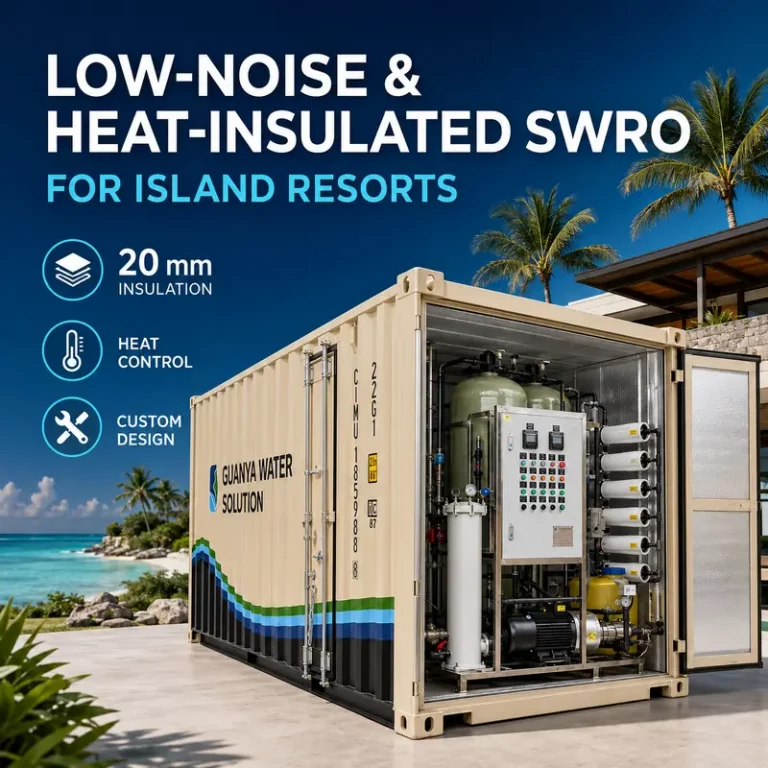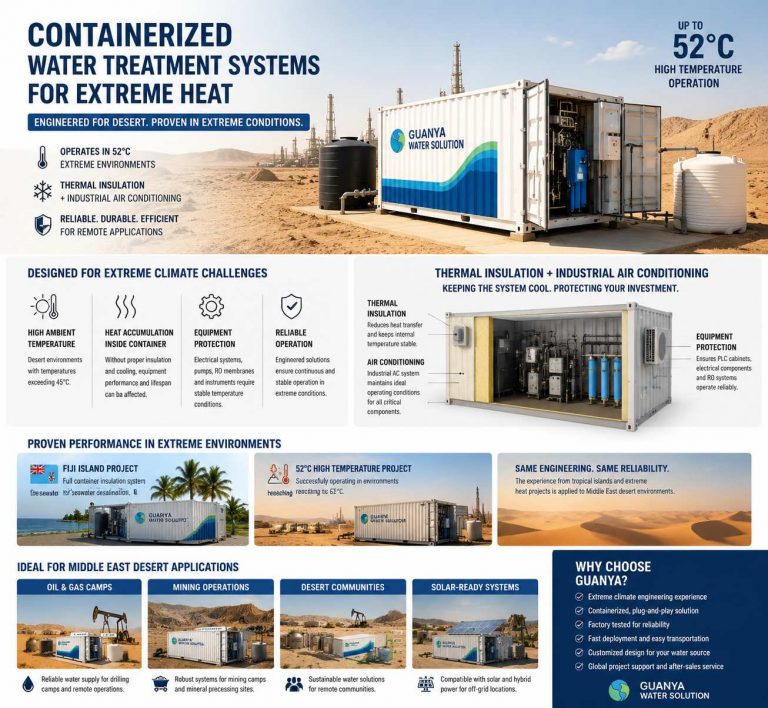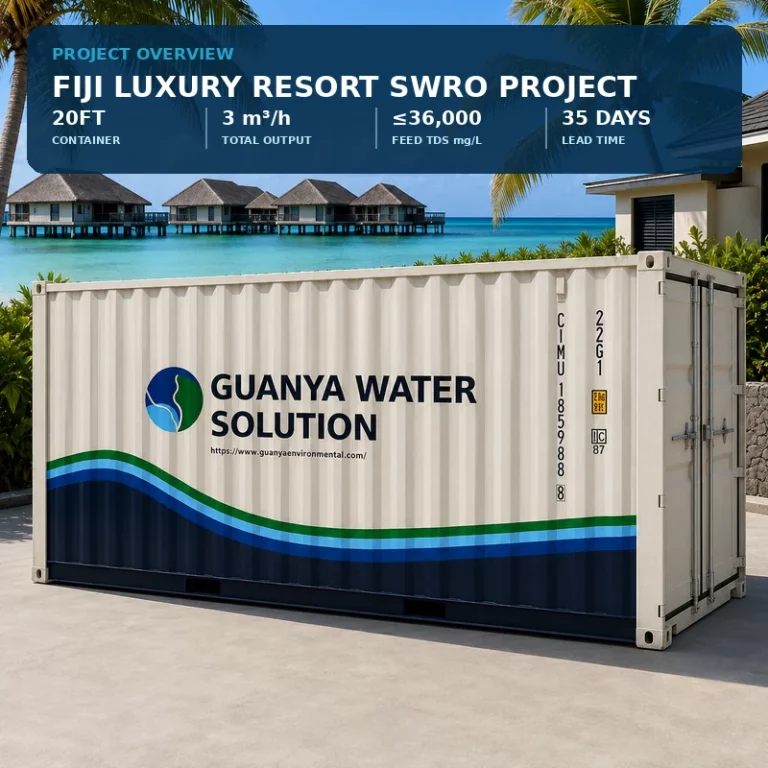
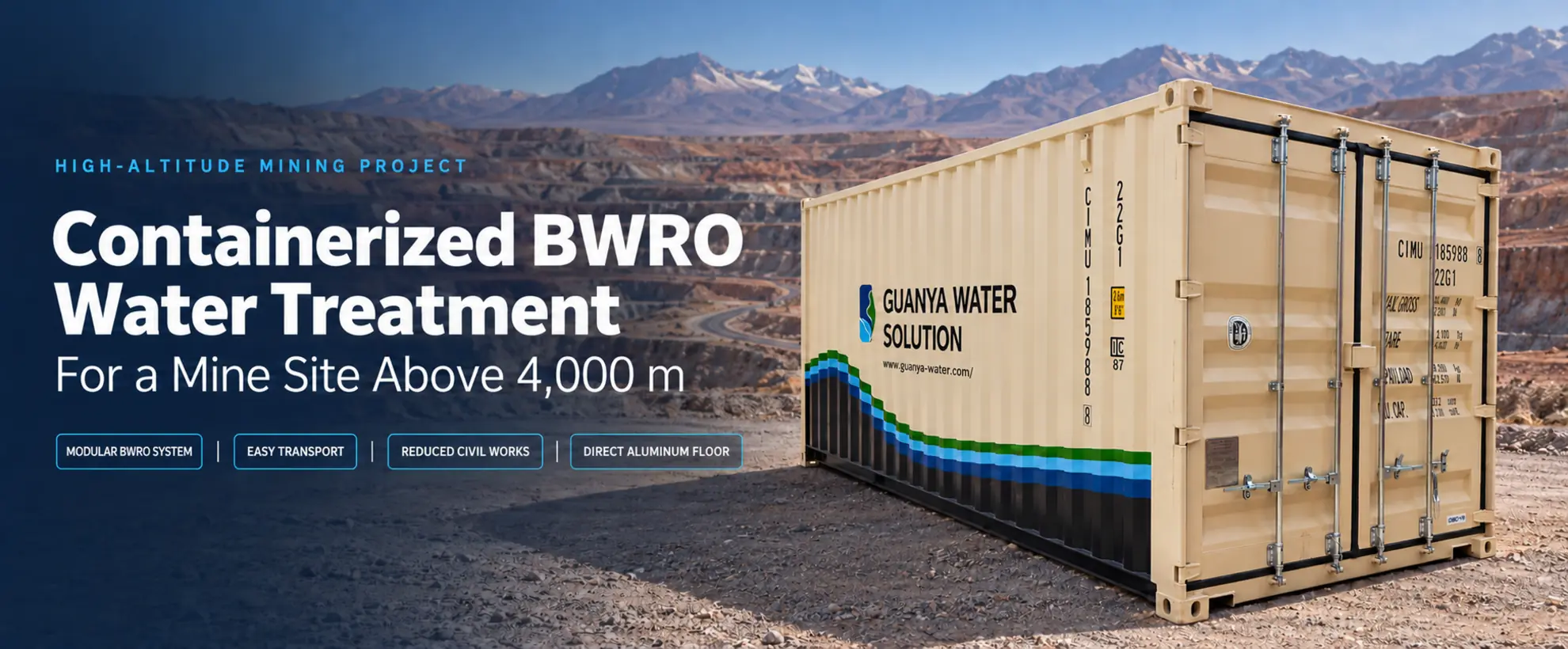
For this mine water treatment project above 4,000 meters, the engineering team developed a compact containerized reverse osmosis system for a remote site with difficult transport, limited field construction resources and demanding environmental conditions. The solution combined altitude-corrected equipment selection, direct aluminum flooring, insulated and temperature-controlled construction, corrosion-resistant wetted materials, automated dosing and practical external CIP connections. The modular design also reduced the amount of civil work and skilled labor required at the mine.
Project Background
The client required a reliable water treatment package for a high-altitude mining area. The source water was mineralized and required broad dissolved-salt removal to meet the project product-water target. At the same time, the treatment plant had to be transported over a long and difficult route, installed within a limited construction window and maintained with fewer specialist resources than would normally be available at an urban industrial site.
Because of the confidentiality agreement, this case study does not publish the project name, country, plant capacity, detailed water analysis, equipment brands or guaranteed performance values. The focus is the engineering logic that made the system practical for a mine above 4,000 meters.
The Main Project Challenges
High-altitude mining projects often require potable water, camp water or process make-up water in locations where logistics and field construction are difficult. The treatment system must therefore solve two problems at the same time: meeting the required water quality and remaining operable in a remote, harsh environment.
The engineering review should cover raw-water chemistry, product-water requirements, minimum ambient temperature, daily temperature range, atmospheric pressure, power quality, road limits, lifting conditions, available operators and the expected maintenance interval. Treating any of these inputs as an afterthought can create avoidable commissioning and reliability problems.
Solution 1: A Containerized RO System for Remote Delivery
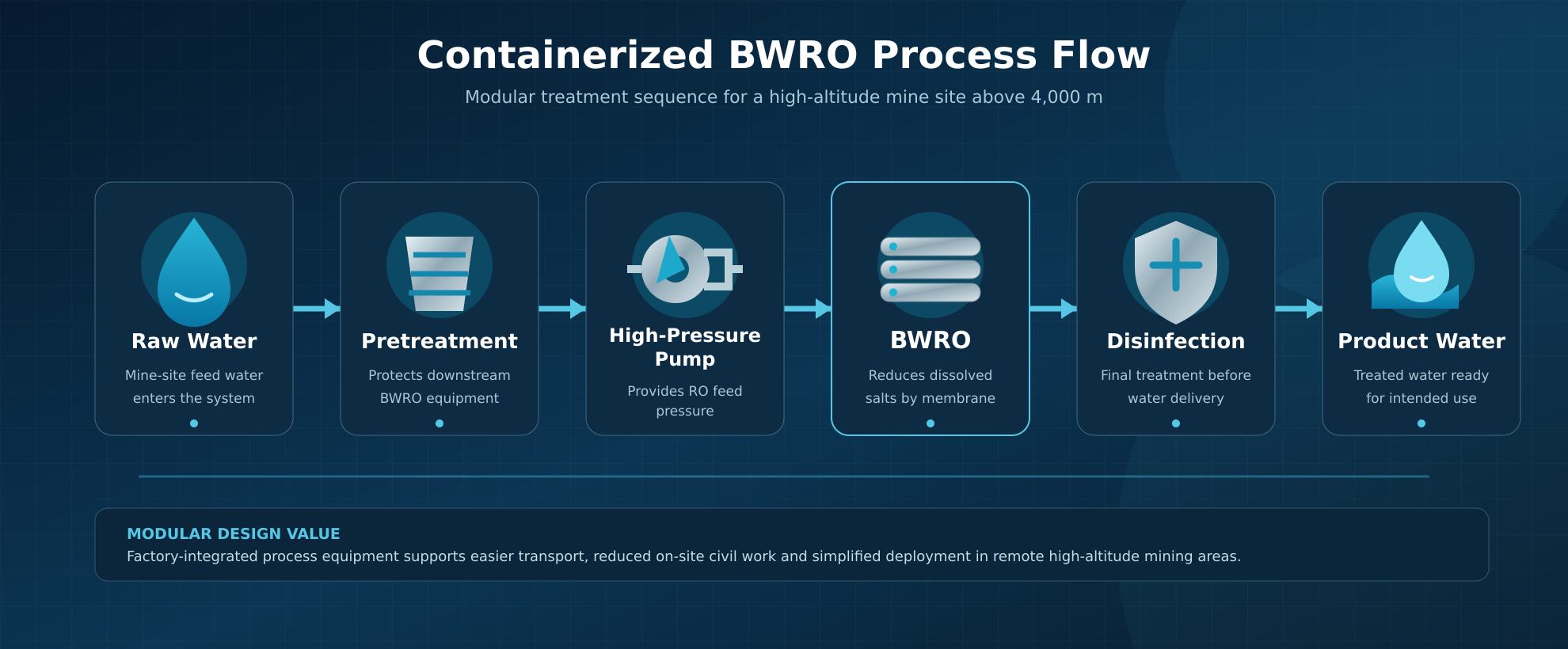
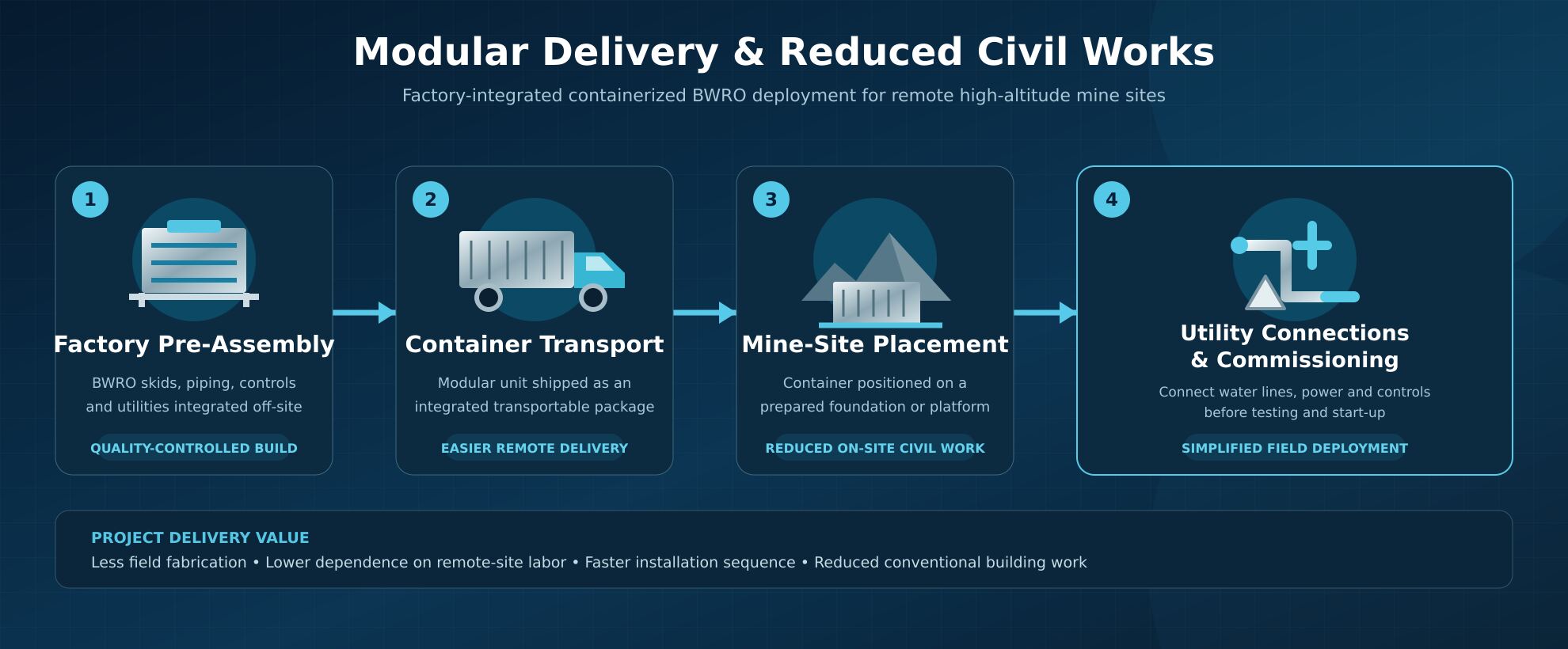
A containerized RO system integrates the pretreatment equipment, RO skid, pumps, chemical dosing, instruments, controls and internal piping before shipment. Factory assembly moves a large share of the work away from the mine site and into a controlled production environment.
Simpler transport: Standard container dimensions support road, rail and multimodal logistics while the enclosure protects equipment during long-distance shipment.
Less on-site civil work: The project can avoid constructing a complete treatment building and reduce field pipe fabrication, cable installation, structural supports and interior finishing.
Lower demand for site labor: Factory preassembly, prewiring and functional testing reduce the number of skilled trades required at altitude.
Faster installation: Site work is largely limited to foundation preparation, positioning, external utility connections and commissioning.
Improved quality control: Piping, electrical work, pressure testing and control logic can be inspected and documented before dispatch.
Future relocation or expansion: Standardized external interfaces make modular replacement, relocation and staged capacity additions more practical.
Containerization does not eliminate engineering. Total shipping weight, center of gravity, lifting points, internal equipment restraints, road vibration and service clearances must still be verified for the final configuration.
Solution 2: Direct Aluminum Flooring Instead of a Wood Floor
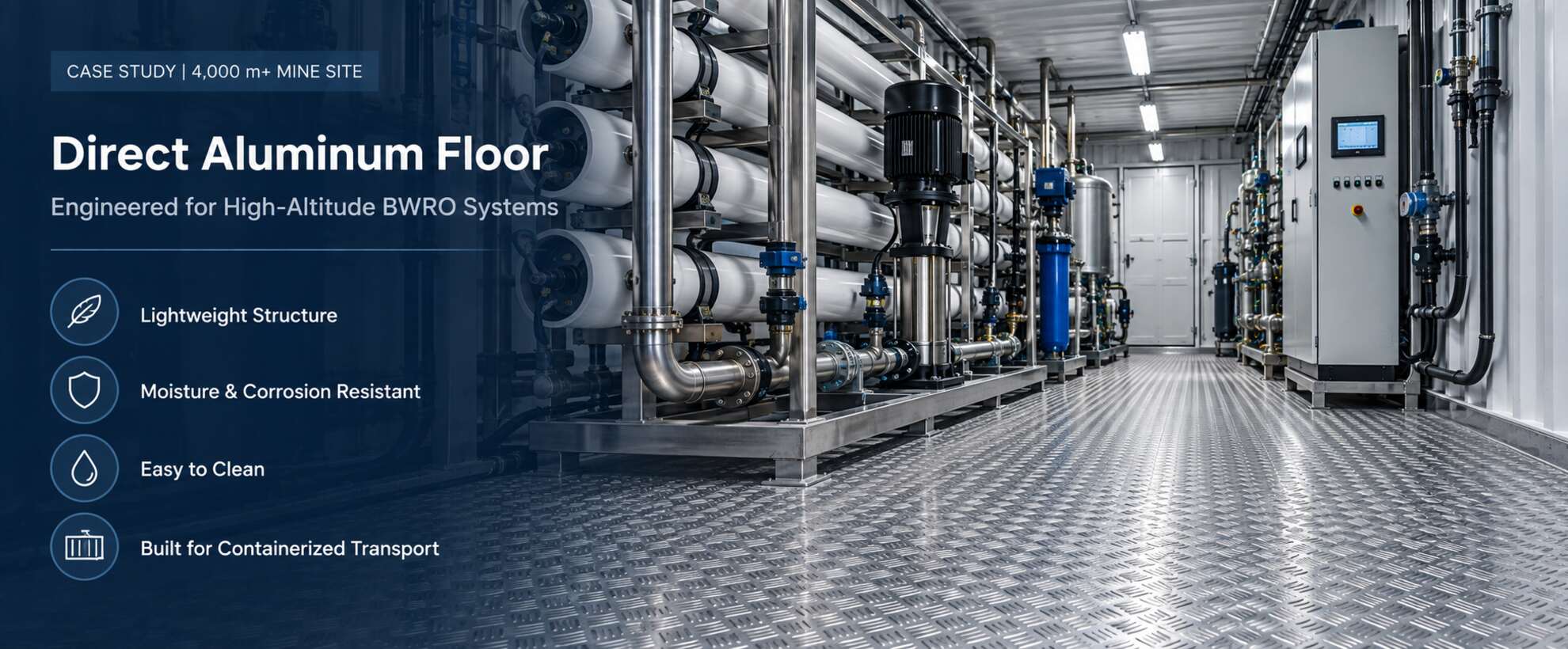
In this design approach, the equipment container uses an aluminum floor directly; it is not an aluminum sheet installed over a wood floor. This distinction matters because a water treatment container is a wet-service technical space exposed to splash water, washdown, condensation and chemical handling.
Key advantages of a direct aluminum floor
Moisture resistance: Aluminum does not absorb water, swell, rot or delaminate in the way an exposed wood-based floor may under repeated wet conditions.
Easier cleaning: A continuous metal working surface is more suitable for routine wiping and controlled washdown around filters, dosing units and pump skids.
Improved wet-area safety: A checker-plate or anti-slip surface can improve traction for operators when the floor is damp.
Lower structural weight: Aluminum provides a favorable strength-to-weight ratio and can reduce container tare weight compared with a heavier steel floor designed for the same service intent.
Better transport efficiency: Reducing unnecessary structural mass helps control gross shipping weight, axle-load planning and lifting demand on difficult access routes.
Longer service life in wet duty: Correct alloy selection, drainage and isolation details can provide a durable floor for repeated operation and maintenance.
The aluminum alloy, plate thickness, support spacing, weld or fastening method, drainage slope, concentrated equipment loads and transport loads must be checked by the container and structural designer. Aluminum also requires proper isolation where it contacts dissimilar metals to manage galvanic-corrosion risk. Lightweight construction is an engineered outcome, not a reason to reduce structural safety factors.
Solution 3: Altitude-Corrected Motors, Pumps and Variable-Frequency Drives
At more than 4,000 meters above sea level, lower air density reduces convective cooling. Motors, variable-frequency drives and electrical components should be selected using manufacturer altitude-derating data, rather than their sea-level nameplate capacity alone.
Motor output, insulation class, temperature rise and cooling method should be reviewed for the design altitude.
Pump suction conditions and net positive suction head margin should be rechecked against the lower atmospheric pressure.
The RO high-pressure pump can use variable-frequency control to reduce starting shock and adjust pressure as feed temperature, membrane condition and production demand change.
Electrical cabinets require coordinated thermal management, dust control and altitude correction for drives, breakers and other heat-producing components.
Pressure, flow, conductivity, tank level and temperature signals should be linked to automatic limiting, alarms and safe shutdown logic.
Solution 4: Insulation, Temperature Control and Freeze ProtectionLarge day-night temperature changes can affect membrane flux, chemical behavior, instrument accuracy and piping integrity. The container should use a continuous insulation system and an engineered heating, cooling or ventilation strategy that maintains the equipment within its allowable operating range.
External connections, dead legs, drain points, sample lines and standby periods require special attention. Where freezing is possible, the design may include heat tracing, insulation, low-point drainage or a defined shutdown drain-down procedure. These provisions should be designed before fabrication rather than added after equipment arrives on site.
Solution 5: BWRO Process Selection for Mineralized Mine Water
Mine-site source water may contain elevated dissolved salts, chloride and site-specific constituents such as boron or arsenic. Membrane selection should therefore be based on a complete water analysis and the required product-water specification. Total dissolved solids alone is not enough for final design.
Where broad dissolved-salt removal is required, brackish-water reverse osmosis may offer a more appropriate treatment barrier than a selective desalination process. Final membrane selection, recovery, flux and staging should be confirmed through membrane projection software and an assessment of scaling, fouling, temperature and pretreatment performance.
Use representative raw-water data, including seasonal variation, rather than a single sample.
Confirm the applicable potable-water or process-water standard before selecting the membrane and post-treatment steps.
Evaluate antiscalant demand, pH, oxidation-reduction conditions, suspended solids and biological risk as one treatment train.
If the RO concentrate retains sufficient pressure, a hydraulic review may allow discharge to a concentrate tank without a separate transfer pump, reducing equipment count and energy use.
Solution 6: Corrosion-Resistant Wetted Materials
For chloride-bearing brackish water, the material strategy should cover the entire wetted path. AISI 316L stainless steel can be specified for centrifugal-pump casings, impellers and shafts where justified by the water chemistry. Its low-carbon composition supports weld-area performance and resistance to intergranular corrosion.
Upgrading only the pump is not enough. Piping, valves, instrument bodies, fasteners, seals and chemical lines must be checked as a compatible materials system. Chemical concentration, temperature, cleaning solutions and stagnant conditions should be included in the review.
Solution 7: Practical CIP Design Within a Compact Footprint
A standard container has limited internal height and floor area. If a complete clean-in-place package cannot be accommodated without compromising access, the system can provide standardized CIP supply and return connections while locating the cleaning tank or selected piping outside the container.
Supply a correctly sized CIP pump and cartridge filter with the main treatment package when appropriate.
Define connection sizes, flow direction, drain routing and operating responsibility in the interface schedule.
Protect an external CIP tank and piping against freezing, chemical exposure and uncontrolled discharge.
Maintain removal space around membrane vessels, cartridge filters, valves and instruments.
Where two online chemical metering pumps cannot fit, one operating pump plus a complete capital spare can be used if the replacement and recommissioning procedure is clearly documented.
Solution 8: Automated Chemical Dosing and Final Disinfection
A typical RO treatment train may include three independent chemical dosing functions: feed-water disinfection, dechlorination for membrane protection and antiscalant dosing. Actual chemicals and dose rates must be established from water chemistry, membrane limitations and commissioning results. Low tank level, no-flow and dosing-pump-failure interlocks help prevent operation outside the intended chemical conditions.
Where the treated water is intended for potable use, ultraviolet disinfection can be installed downstream of the RO system as an additional microbiological barrier. UV equipment must be sized using validated flow, UV transmittance and target dose—not by nominal pipe diameter alone.
Additional Reliability Measures Applied to the Project
Remote monitoring: Record differential pressure, flow, conductivity, temperature, chemical levels, operating hours and alarm history for off-site troubleshooting.
Spare-parts planning: Classify cartridges, seals, probes, dosing pumps, electrical components and membrane elements as consumables, critical spares or capital spares.
Power resilience: Review generator operation, voltage variation, staged starting, restart logic and controlled recovery after outages.
Seasonal source-water changes: Verify turbidity, salinity, temperature and scaling limits for dry-season, wet-season and winter conditions.
Chemical and operator safety: Address ventilation, secondary containment, emergency washing, lighting, escape access, noise and electrical protection.
Maintainability: Confirm that routine service can be completed with the tools, lifting equipment and personnel realistically available at the mine.
How the Project Was Engineered and Delivered
1. Define the design basis. Confirm raw-water analysis, product-water use, applicable standard, peak demand, minimum temperature, altitude, power source and operating philosophy.
2. Apply altitude corrections. Verify motors, drives, pump suction, cabinet cooling, instruments and membrane performance at the specified elevation.
3. Complete modular engineering. Finalize container structure, direct aluminum floor, weight distribution, service access, external interfaces and CIP boundaries.
4. Factory assemble and test. Complete pressure tests, flushing, instrument calibration, control interlocks and transport-restraint inspection before shipment.
5. Connect and commission on site. Position the container, connect utilities, verify performance, train operators and hand over spares and maintenance procedures.
What This Case Demonstrates
This project demonstrates that high-altitude mine water treatment is best addressed as an integrated logistics, structural, mechanical, electrical and process-design challenge. The value of the solution came not from a single component, but from aligning the container structure, aluminum floor, RO process, altitude-rated equipment, thermal management, materials, controls and maintenance strategy around the actual mine conditions.
The case also shows why modular water treatment can reduce project execution risk. Completing more fabrication and testing in the factory reduced the volume of work transferred to the high-altitude site. The result was a system designed for easier transport, a shorter installation sequence and more predictable long-term maintenance, without disclosing confidential project performance data.
Frequently Asked Questions
Can a standard RO system operate at a mine site above 4,000 meters?
Not without verification. Motors, drives, pump suction conditions, membrane performance, cabinet cooling, instruments and freeze protection should all be checked for the actual altitude and climate.
Why use a containerized water treatment plant at a remote mine?
It moves assembly and testing into the factory, simplifies transport, reduces on-site civil work and skilled labor, and shortens the installation period in difficult weather.
Is the aluminum floor installed over a wood floor?
No. In this design, the container uses a direct aluminum floor rather than a wood floor with an aluminum overlay.
What are the advantages of an aluminum floor in a water treatment container?
It is moisture resistant, easy to clean and suitable for anti-slip surface treatment. Its favorable strength-to-weight ratio can also reduce structural mass compared with a heavier steel-floor solution, subject to load calculations.
Why use a VFD on the RO high-pressure pump at high altitude?
A VFD reduces starting shock and allows pressure and flow to follow actual membrane and production conditions. The drive itself must also be altitude-rated or appropriately derated.
How can CIP be arranged when container space is limited?
The container can include standard CIP supply and return ports while the cleaning tank or selected piping is installed externally. Freeze protection, drainage and chemical safety must be included in the interface design.
How should the membrane process be selected for mine water?
Use a complete and representative water analysis, product-water requirements, temperature range, scaling and fouling potential, and membrane projection results. Do not select the process from TDS alone.
Conclusion
This high-altitude mining project required more than a standard RO package. By integrating factory fabrication, containerized transport, reduced civil works, a direct aluminum floor, altitude-corrected motors and drives, thermal control, corrosion-resistant wetted materials, practical CIP interfaces and automated chemical dosing, the project team created a solution suited to operation above 4,000 meters. Although the client and performance data remain confidential, the engineering approach provides a useful reference for future remote mine water treatment projects.