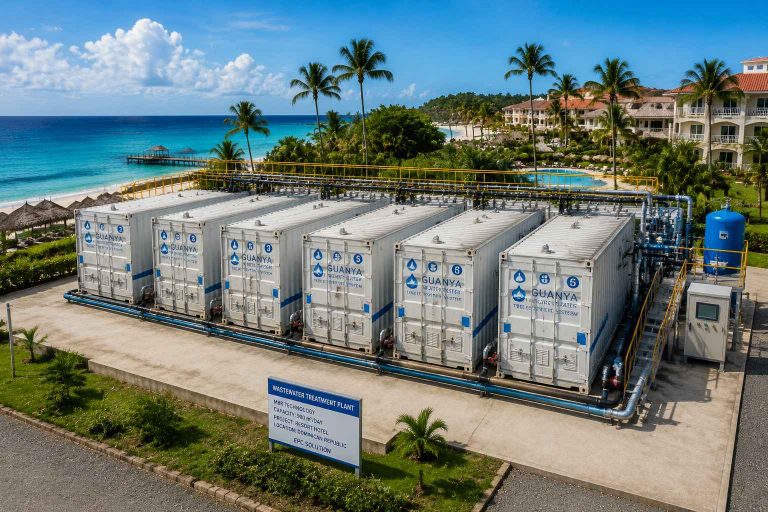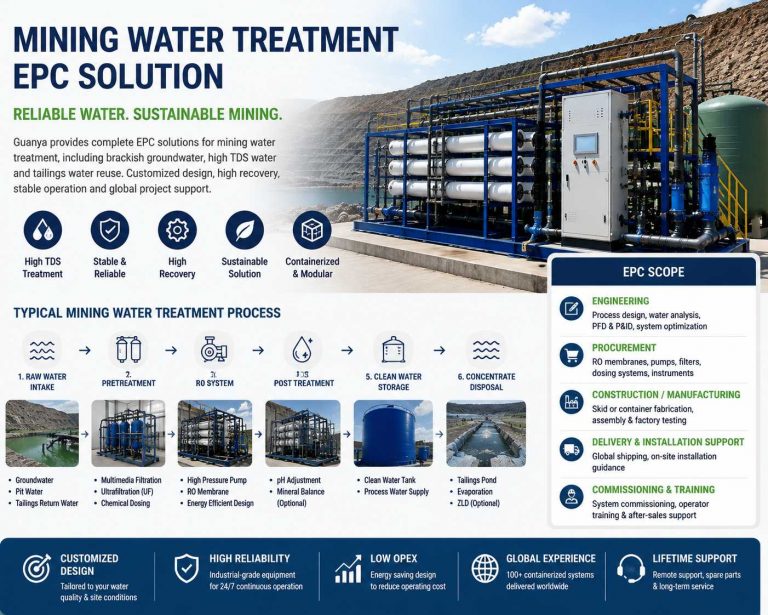
In desert oilfields, remote mining camps, tropical islands, and off-grid industrial sites, water treatment is not merely a process engineering challenge—it is an environmental engineering problem. Guanya Environmental designs and manufactures containerized reverse osmosis (RO) and desalination systems specifically engineered for extreme climates, with verified performance at ambient temperatures reaching 52°C. Our systems integrate industrial-grade thermal insulation, HVAC climate control, and corrosion-resistant design to deliver reliable potable and process water where standard equipment would fail.
Planning a water treatment project in an extreme climate?
Contact Guanya Environmental for a custom system design and quotation tailored to your site conditions and feedwater source.
Request a Custom Quote
Why do standard water treatment systems fail in desert high-temperature environments?
Standard water treatment equipment fails in extreme heat due to three interconnected failure modes: electrical control system overheating and alarm shutdowns, RO membrane performance drift caused by uncontrolled feedwater temperature, and accelerated mechanical wear on pumps, motors, and bearings. In desert summer conditions, ambient temperatures exceed 45°C, and solar radiation can raise steel container surface temperatures above 70°C—far beyond the design envelope of conventional indoor-rated systems.
Electrical control system overheating risks
PLC cabinets, variable-frequency drives (VFDs), and electrical components require stable internal temperatures, typically below 40°C. When container interior temperatures climb past this threshold, systems trigger protective alarm shutdowns. Prolonged exposure to heat accelerates electrolytic capacitor aging, solder joint fatigue, and insulation degradation, leading to cascading reliability failures. In a 50°C ambient environment, an uninsulated container can reach internal temperatures of 60°C or higher—conditions that will disable most standard control systems within hours.
RO membrane performance degradation at high temperature
Reverse osmosis membranes are sensitive to feedwater temperature because it directly affects water viscosity, solute diffusion rates, and membrane compaction. Higher temperatures increase membrane flux (water permeability) but reduce salt rejection. For every 1°C rise above the design setpoint, salt rejection typically declines by 0.1%–0.2%, and permeate conductivity can increase by 20%–30% at 50°C if the system lacks temperature management. Additionally, higher temperatures increase the required operating pressure to maintain flux, placing additional mechanical load on high-pressure pumps.
Pump and mechanical component thermal stress
High-pressure pumps, motors, bearings, and instrumentation all experience accelerated degradation under sustained thermal load. Lubricant viscosity drops, reducing film strength and increasing metal-to-metal contact. Elastomeric seals harden and lose elasticity. Instrument calibration drifts. In remote locations where maintenance resources are limited, these thermal-stress failures translate directly into unplanned downtime and increased lifecycle cost.
How does Guanya Environmental design containerized water treatment systems for 52°C ambient conditions?
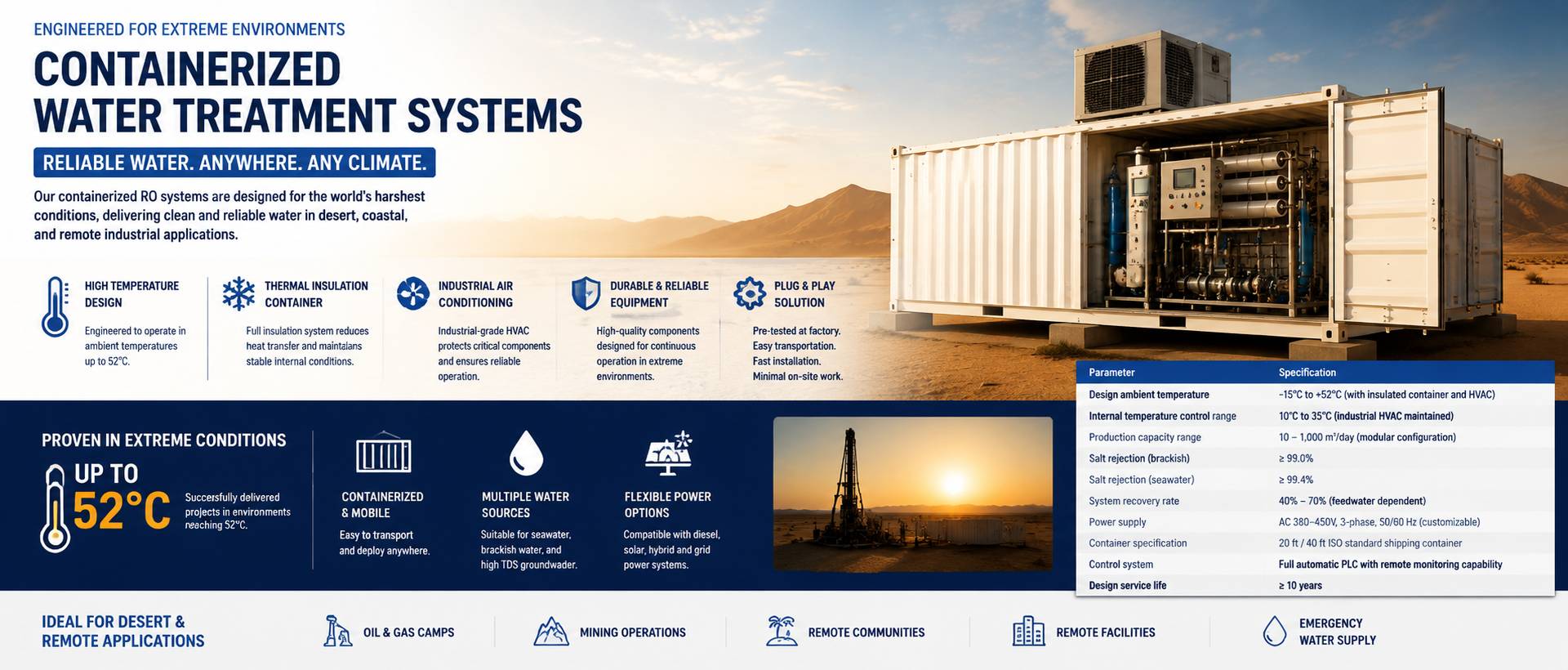
Guanya Environmental treats the shipping container not as a transport box, but as a controlled equipment room. Our extreme-climate engineering strategy combines four layers: thermally insulated container structures, industrial-grade HVAC for active temperature control, corrosion-resistant materials derived from tropical island desalination experience, and comprehensive factory acceptance testing (FAT) before shipment. This integrated approach ensures continuous, reliable operation at 52°C ambient and beyond.
Thermally insulated container structure design
For extreme environments, we engineer the container as a thermal barrier, not just a weather shield. Our approach includes:
High-R-value thermal insulation materials in walls, roof, and floor assemblies
Heat-resistant wall structures with radiant barrier layers to reflect solar gain
Reduced thermal bridging at structural connections and penetrations
Internal temperature protection zones isolating heat-generating equipment from sensitive electronics
This design reduces solar heat transfer into the container interior by over 60%, lowering the baseline thermal load that the HVAC system must manage.
Cross-section diagram of Guanya containerized RO system showing thermal insulation layers, radiant barrier, and HVAC airflow path
Multi-layer thermal insulation and radiant barrier design for 50°C+ environments
Industrial-grade HVAC for active equipment protection
For high-temperature projects, Guanya integrates industrial air-conditioning systems directly into the containerized water treatment unit. The cooling system maintains stable internal conditions for:
PLC control panels and HMI interfaces
Electrical cabinets and VFD enclosures
RO membrane housings and instrumentation
High-pressure pumps and motors
Industrial HVAC is not an optional add-on for desert projects—it is a mandatory engineering layer. Our systems are sized for the full thermal load envelope, including solar gain, equipment waste heat, and infiltration, ensuring that internal temperatures remain within manufacturer-specified operating ranges 24/7.
Engineering experience from tropical island desalination projects
Extreme climate challenges are not limited to deserts. Island projects present a different but equally severe set of environmental stressors: intense solar radiation, high humidity, salt-laden atmospheric corrosion, and limited maintenance access. For seawater desalination projects in island environments, Guanya has successfully applied:
Full-container insulation systems
Industrial-grade air conditioning
Corrosion-resistant design (stainless steel hardware, epoxy coatings, marine-grade electrical enclosures)
Remote monitoring and diagnostics to reduce on-site maintenance requirements
The same engineering principles—thermal management, corrosion protection, and remote operability—transfer directly to Middle East desert applications, where sand abrasion and diurnal temperature swings add additional stress.
Proven performance in 52°C ambient environment projects
Guanya has field-proven experience designing containerized water treatment systems for environments reaching approximately 52°C ambient operating conditions. These projects required special consideration of:
Container thermal protection and solar load calculation
Equipment cooling duty sizing and redundancy
Electrical stability under sustained thermal load
Continuous operation reliability with minimal maintenance access
The operational data and lessons learned from these extreme-climate deployments provide a validated engineering baseline for future desert water treatment projects.
What are the typical applications for containerized RO systems in Middle East desert regions?
Containerized RO systems with extreme-climate protection serve three primary market segments in the Middle East: oil and gas remote camps, mining operations, and remote or emergency community water supply. Water sources include brackish desert groundwater, high-TDS wells, and coastal seawater, each requiring different process configurations within the same containerized platform.
Oil & gas remote camp water supply
Applications: Oilfield accommodation camps, drilling camps, and remote operation bases.
Water sources: Brackish groundwater, desert wells, and high-TDS aquifers.
In these settings, water treatment systems must operate continuously with minimal on-site technical staff. Containerized systems arrive factory-tested, require only utility connections, and include remote monitoring capabilities that allow centralized technical support to diagnose and resolve issues without dispatching personnel to the field. This operational model is critical for camps located hundreds of kilometers from the nearest service center.
Containerized RO water treatment system deployed at a remote oilfield camp in the Middle East desert
Containerized RO system supplying potable water to a remote oilfield accommodation camp
Mining operations water treatment
Applications: Remote mining camps, mineral processing sites, and worker accommodation facilities.
Advantages of containerized systems for mining:
Rapid deployment: Systems can be operational within days of arrival, critical for project schedules
Minimal civil construction: No need for permanent buildings or foundations
Factory-tested reliability: FAT eliminates commissioning surprises in remote locations
Modular scalability: Additional containers can be added as production or camp population expands
Remote communities and emergency water supply
Applications: Remote villages, emergency water supply, and off-grid locations.
Possible configurations:
Brackish water RO for inland communities with groundwater access
Solar-powered RO for locations without grid electricity
Hybrid power systems combining solar, battery storage, and backup diesel generation
How do containerized systems compare to conventional built-in-place water plants for extreme environments?
Compared to traditional construction-based water plants, containerized systems reduce installation time by over 70%, provide superior equipment protection through a sealed climate-controlled envelope, simplify global logistics via standard shipping container dimensions, and eliminate commissioning risk through comprehensive factory acceptance testing (FAT) before shipment.
Faster installation and reduced site construction
Factory-built systems arrive as fully assembled, pre-tested units. Site work is limited to foundation preparation, utility connections, and startup commissioning. In extreme heat environments, minimizing on-site construction directly reduces worker heat exposure, shortens project schedules, and eliminates the need for temporary site infrastructure such as equipment shelters and climate-controlled storage.
Superior equipment protection
The container provides a multi-functional protective envelope:
Weather protection: Sealed against sand, dust, and rain ingress
Security: Lockable, tamper-resistant steel enclosure
Controlled operating environment: Insulated and HVAC-conditioned interior maintaining stable temperature and humidity for sensitive equipment
Easier transportation to remote sites
Standard ISO container dimensions (20-foot and 40-foot) integrate seamlessly with global maritime, rail, and road logistics networks. Whether the destination is a desert interior, an island with limited port facilities, or a remote industrial area, containerized systems can reach the site using existing transport infrastructure without requiring specialized heavy-lift equipment or oversized load permits.
Lower project risk through factory acceptance testing
Before shipment, Guanya performs comprehensive factory testing including:
Mechanical inspection and leak testing
Electrical testing and control logic verification
Hydrostatic pressure testing of all pressure vessels and piping
System operation verification under simulated load conditions
Performance validation against design specifications (flow, pressure, TDS rejection)
FAT ensures that the system is proven before it leaves the factory, dramatically reducing the risk of discovering integration or performance issues during on-site commissioning in a remote, high-temperature location.
Containerized RO vs. Built-in-Place Water Plant for Extreme Climates
Factor Containerized System Built-in-Place Plant
Installation time 1–3 days on site 3–6 months construction
Civil construction Minimal (level pad only) Full building, foundation, piping
Equipment protection Sealed, insulated, HVAC-controlled Requires separate building/enclosure
Factory testing Complete FAT before shipment Site commissioning only
Transport to remote site Standard logistics, global reach Modular or on-site fabrication
Scalability Add containers as needed Requires new construction
What customized extreme-climate water treatment solutions does Guanya Environmental offer for Middle East customers?
Guanya Environmental provides three categories of customized containerized systems for Middle East customers: brackish water RO for inland desert groundwater, seawater desalination for coastal industrial facilities, and solar-ready systems for off-grid and remote community applications. Each system is engineered to the specific feedwater chemistry, ambient climate envelope, and power infrastructure of the project site.
Containerized brackish water RO systems
For: Desert groundwater, oilfield camps, and remote industrial facilities.
Brackish water RO systems treat groundwater with TDS levels typically ranging from 1,000 to 15,000 mg/L. In desert environments, groundwater often contains elevated levels of silica, hardness, and specific ions such as boron or fluoride that require pre-treatment optimization. Guanya customizes pre-treatment trains (filtration, softening, antiscalant dosing) and membrane selection to match the specific feedwater analysis, ensuring designed permeate quality and maximizing membrane life.
Containerized seawater desalination systems
For: Coastal industries, ports, and remote coastal facilities.
Seawater desalination requires higher operating pressures (typically 55–70 bar) and specialized seawater RO membranes. In high-temperature coastal environments, additional challenges include elevated feedwater temperature, biofouling risk, and salt-air corrosion. Guanya seawater systems incorporate energy recovery devices (ERDs) to reduce power consumption, corrosion-resistant materials (super-duplex stainless steel, FRP, epoxy coatings), and robust pre-treatment to manage suspended solids and biological loading.
Guanya containerized seawater desalination system with energy recovery device for coastal industrial application
Containerized seawater desalination system with integrated energy recovery
Solar-ready water treatment systems
For: Off-grid applications, remote communities, and emergency water supply.
Solar-ready configurations are designed with variable-frequency drives (VFDs) that can accept direct DC input or AC from solar inverters, along with power management logic that optimizes system operation across varying solar irradiance. Battery energy storage system (BESS) interfaces allow the system to operate during low-light or nighttime periods. For locations with unreliable grid power, hybrid configurations combine solar, battery storage, and diesel generator backup to ensure 24/7 water production.
Technical specifications and performance parameters
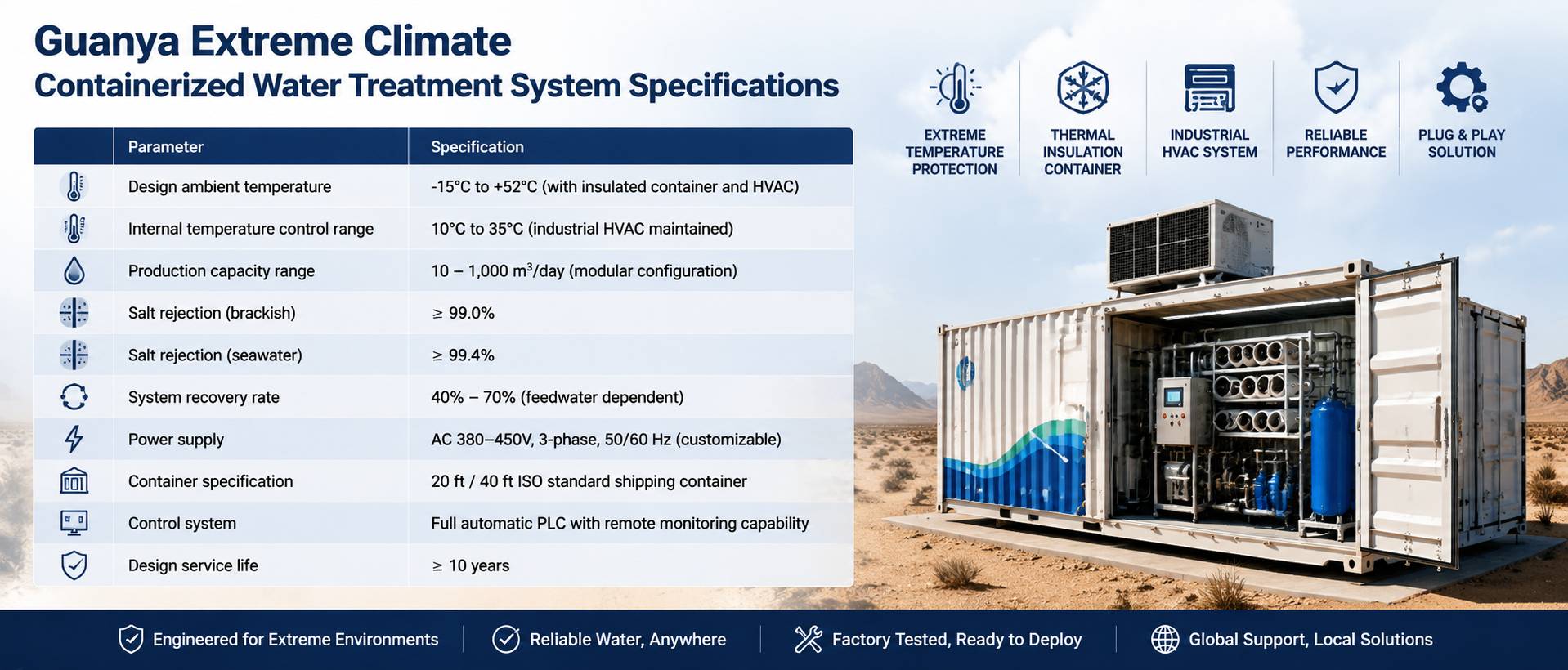
The following are representative technical parameters for Guanya extreme-climate containerized systems. Specific configurations are customized based on feedwater analysis, ambient conditions, and client requirements.
Frequently asked questions (FAQ)
How do containerized water treatment systems protect electrical components at 50°C ambient temperature?
Containerized systems use a three-layer thermal protection strategy: (1) insulated container walls with high-R-value materials to reduce solar heat transfer; (2) industrial-grade HVAC maintaining internal temperatures between 10°C and 35°C; (3) independently ventilated PLC enclosures with forced-air cooling. Even at 52°C external ambient, internal electrical cabinets remain within rated operating ranges, preventing alarm shutdowns and component aging.
What is the impact of high temperature on RO membrane salt rejection performance?
For every 1°C increase in feedwater temperature, RO membrane flux rises by approximately 3%, while salt rejection decreases by 0.1%–0.2%. At 50°C, an uncontrolled system can experience a 20%–30% increase in permeate conductivity. Guanya systems mitigate this through active temperature management, optimized operating pressure, and membrane selection calibrated for high-temperature feedwater, maintaining designed permeate quality across the full ambient range.
What is the delivery timeline and site installation requirement for a containerized RO system?
Standard delivery is 20–30 days including factory acceptance testing (FAT). Site installation requires only a level, hard-standing surface and utility connections (power and feedwater). No complex civil construction is needed. After arrival, commissioning and startup typically take 1–3 days, significantly reducing on-site labor exposure in extreme heat environments.
Do containerized desalination systems support solar or hybrid power supply?
Yes. Guanya offers solar-ready configurations with integrated photovoltaic array interfaces, battery energy storage system (BESS) compatibility, and variable-frequency drives (VFD) optimized for fluctuating power input. Systems can operate on pure solar, diesel-solar hybrid, or grid-solar hybrid modes, making them ideal for off-grid desert camps and remote island communities.
What is the difference between a containerized RO system and a conventional built-in-place water plant for desert environments?
Containerized systems reduce installation time by over 70%, eliminate most on-site civil construction, and provide a sealed, climate-controlled equipment room that protects against sand, dust, and thermal stress. Factory pre-testing (FAT) verifies mechanical, electrical, and operational performance before shipment, reducing commissioning risk in remote locations. Standard container dimensions also simplify global logistics to desert, island, and industrial sites.
Conclusion: Reliable water treatment beyond climate limits
Extreme environments demand more than standard water treatment equipment. A successful desert RO project requires the integration of correct water treatment process design, container thermal engineering, active temperature control, equipment protection strategy, comprehensive factory testing, and remote technical support capability.
With proven experience in high-temperature environments, island desalination projects, and containerized water treatment solutions, Guanya Environmental delivers reliable systems for the world’s most challenging locations. From tropical islands to Middle East deserts, our objective remains the same: reliable water supply in the most demanding environments.
Ready to start your extreme-climate water treatment project?
Contact the Guanya Environmental engineering team for a customized system design and quotation based on your site location, feedwater source, and climate conditions.