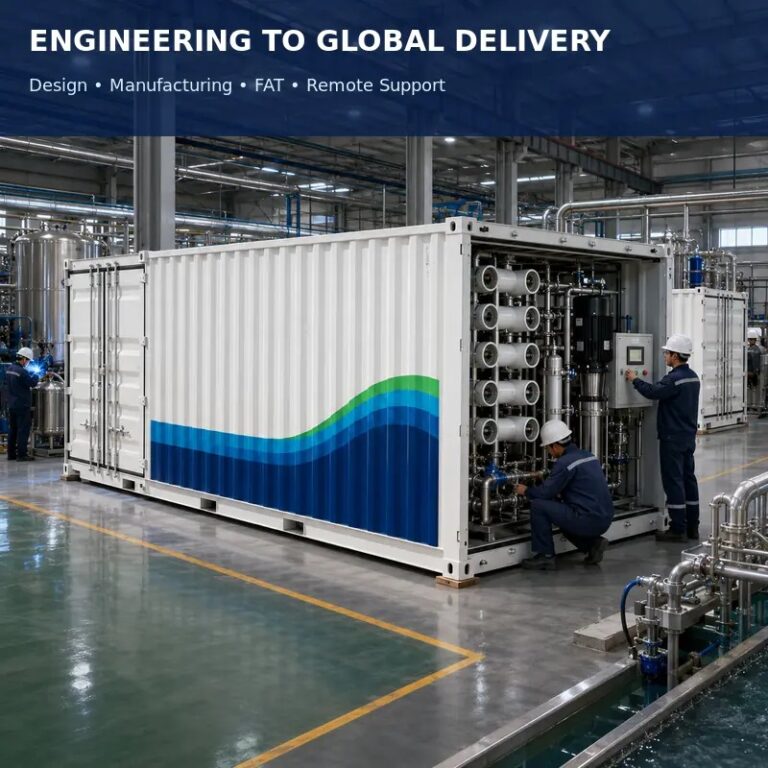
A new large project finished, the solution and waste water treatment equipment provided by our factory, for the equipment to treat the landfill leachate.

The solution for this project and equipment we provide is the integrated equipment, all the detailed parts are in container which is quite easy to install and operation. The containerized equipment arrived at site, connect to the electricity and water then it can works. We have rich experience in water treatment solutions.
Leachate from garbage refers to a high concentration wastewater formed by the water contained in the garbage itself, the rain, snow, and other water entering the landfill, deducting the saturated water holding capacity of the garbage and soil layers, and passing through the garbage and soil layers.
The water quality of landfill leachate is quite complex, generally containing high concentrations of organic matter, heavy metal salts, SS, and ammonia nitrogen. Landfill leachate not only pollutes soil and surface water sources, but also pollutes groundwater. There have been many studies on the removal of CODCr in landfill leachate, and biological methods are generally used for treatment, but the treatment effect is not ideal and the operating cost is relatively high.

The following are some method for the leachate treatment, our engineer team will provide the solution according to the detailed requirement and choose the best way to solve the problem for the leachate problems.
Anaerobic ABR: Design a reasonable and effective program to address the characteristic of increased COD concentration in late stage leachate;
BAF: According to the new standard, increasing the pressure to meet the total nitrogen standard results in better removal of ammonia nitrogen and total nitrogen by BAF compared to other equipment;
Hypoxia reaction tank: can further remove total nitrogen;
Ultrafiltration membrane bioreactor: effectively improves the concentration of sludge in the biochemical unit, removes pollutants such as organic matter, ammonia nitrogen, and total nitrogen, and is a pretreatment process before the subsequent operation of the nanofiltration membrane.
Nanofiltration: It intercepts organic matter and heavy metal ions while avoiding the accumulation of heavy metals in the system.
Coagulation sedimentation: Timely treat concentrated water to avoid the accumulation of organic matter in the system during circulation
Frequently Asked Questions
What kind of project is this case study about?
It covers a sanitary-landfill leachate treatment installation, from pretreatment through high-pressure membrane treatment, and how the train was selected from the site’s leachate characteristics.
Where can I see the product system used for landfill leachate?
The containerized landfill leachate treatment system page explains the STRO/DTRO process options. Send a leachate analysis and we can propose a train for your site.
Can this approach handle seasonal leachate flow changes?
Modular trains and equalization are used so the plant can run at part-load in the dry season and full-load in the wet season. Final sizing follows your flow data.
Learn more about the containerized landfill leachate treatment system.
Send Your Water Test Report — Get a Process Design in 48 Hours