By GUANYA WATER SOLUTION
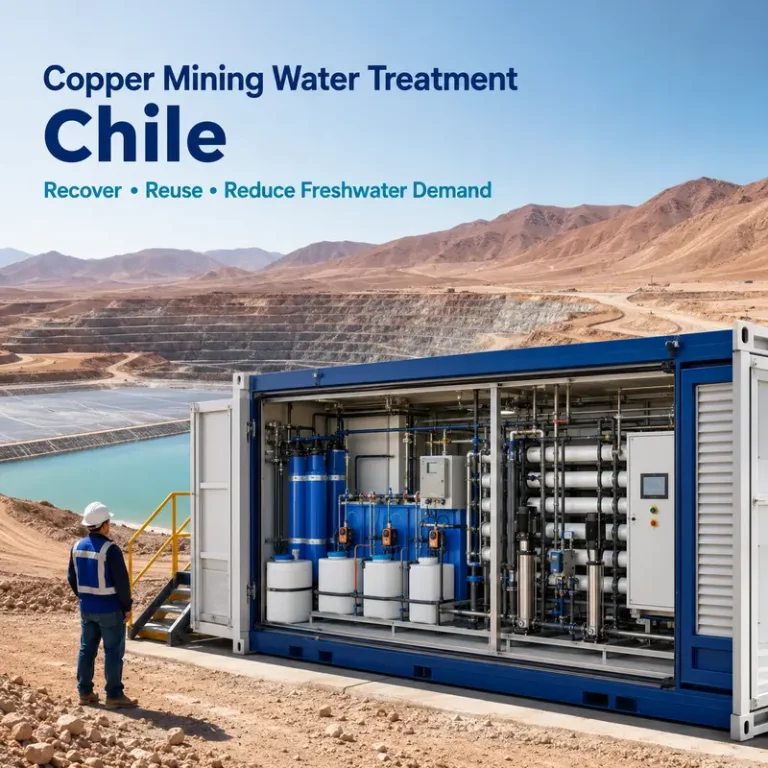
Northern Chile combines three conditions that strongly influence water-treatment design: exceptional solar resources, severe water scarcity and mining operations located far from ports, towns and reliable grid connections. In these locations, every liter of diesel delivered to a camp includes not only the fuel price but also transport, storage, handling and supply-risk costs.
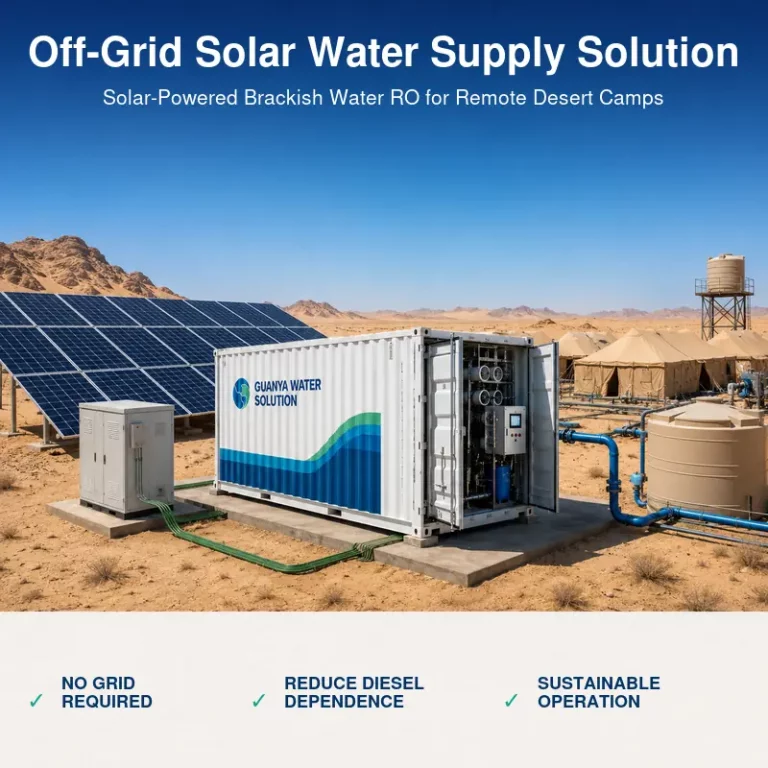
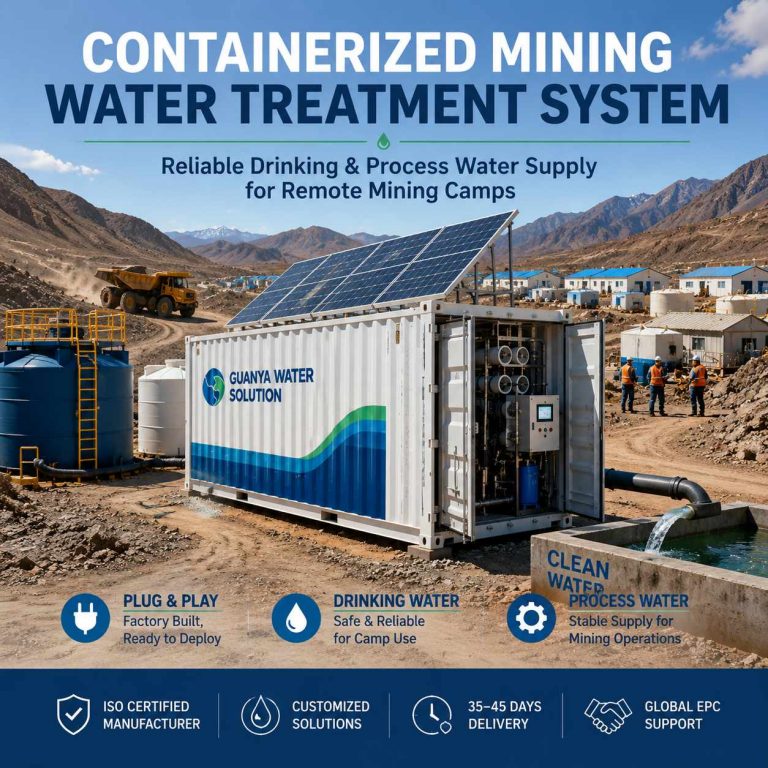
For mobile and containerized reverse osmosis systems, the practical opportunity is not usually “solar only.” It is a solar hybrid architecture in which photovoltaic generation supplies as much of the daytime treatment load as technically and economically reasonable, while the grid, battery storage or diesel generators maintain stable operation when solar output changes. This approach can reduce generator runtime and fuel consumption without making water availability dependent on sunshine alone.
Why this matters for Chilean mining
Chile is already shifting toward greater use of seawater in copper mining. COCHILCO projects total mining water demand to rise from 18.5 m³/s in 2024 to 20.6 m³/s in 2034. Over the same period, seawater is projected to increase from 40.7% to 67.6% of total copper-mining water consumption. This does not mean every mine will install the same desalination plant. It means energy, water transport and treatment configuration must increasingly be evaluated together.
The solar resource is equally important. Chile’s Ministry of Energy describes Atacama as the country’s solar-energy capital. Field research in the coastal and interior Atacama has reported annual plane-of-array irradiation around 2,367 and 2,863 kWh/m² respectively. These values explain why photovoltaic power can be attractive for predictable daytime loads such as RO, pumping and camp utilities, while also showing why site-specific measurements and yield modelling are still required.
A proven mining logic rather than a theoretical concept
At the Salares Norte mine, located at about 4,500 m elevation and 190 km from the nearest town, a 25.9 MW hybrid system was developed with 9.9 MW of solar PV and 16 MW of diesel generation. The scale is much larger than a mobile water-treatment plant, but the operating logic is directly relevant: solar displaces part of the daytime diesel load, and dispatchable generation protects continuity.
First clarify what water is being treated
A technically credible proposal must distinguish seawater desalination from high-altitude brackish-water treatment.
| Water source | Typical equipment location | Main treatment challenge |
|---|---|---|
| Seawater | At the coast or near a marine intake | High-pressure SWRO, intake variability, pretreatment, energy recovery and brine discharge |
| Brackish groundwater | At or near the mine or camp | Site-specific TDS, hardness, silica, arsenic or other contaminants; generally lower RO pressure than seawater |
| Desalinated water pumped to mine | SWRO at coast plus a long conveyance system | Elevation pumping may consume more energy than desalination itself |
| Mine wastewater for reuse | At the operation | Suspended solids, metals, oil, reagents and variable chemistry may require clarification, filtration or membranes |
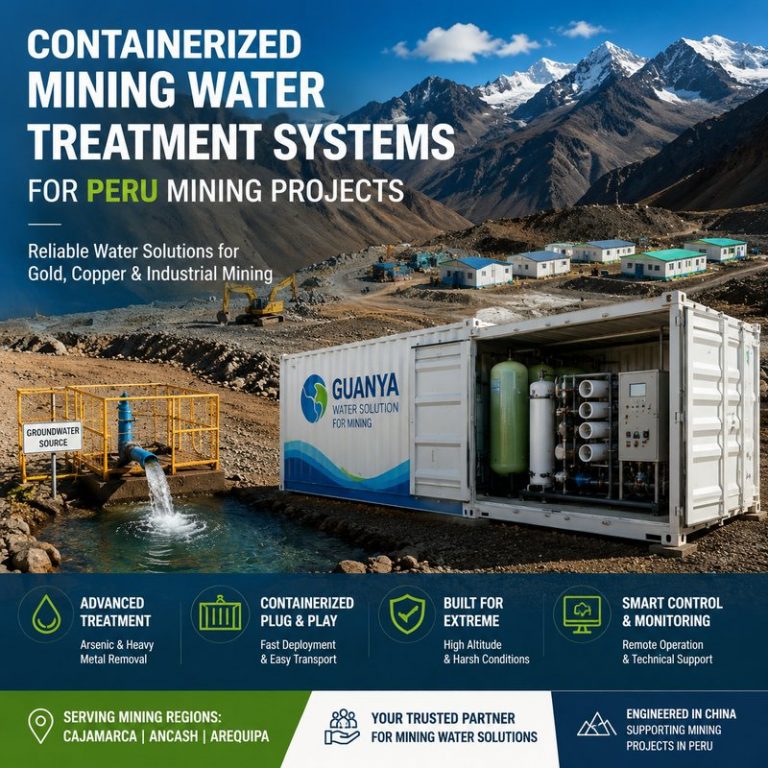
Placing an SWRO unit at a 4,000 m mine is only possible if seawater is first transported there. In many projects, it is more logical to desalinate at the coast and pump product water inland, or to use a mobile BWRO system at the mine when a brackish groundwater source exists. GUANYA configures mobile skid and containerized systems around the actual source water, not around the project label.
Why solar hybrid power fits RO operation
RO is a controllable electrical load. High-pressure pumps, feed pumps and auxiliaries can be scheduled and controlled. With suitable variable-frequency drives and process limits, production can follow an agreed operating window rather than running at one fixed output.
Water storage can be cheaper than oversized batteries. Where the mine has adequate treated-water storage, the plant can produce more during solar hours and use stored water overnight. This shifts part of the energy-balancing task from batteries to tanks.
Diesel remains a reliability layer. For an isolated camp, backup generation may still be necessary. The objective is to reduce generator hours and inefficient low-load operation, not to remove dispatchable power without a reliability study.
Modular equipment matches phased mining. Mobile skids and 20-foot or 40-foot containers can be installed for exploration camps, early works and temporary operations, then expanded or relocated as demand changes.
Illustrative energy and diesel calculation
The following example is a planning illustration, not a performance guarantee. Actual values depend on salinity, temperature, recovery, intake pressure, pretreatment, pump efficiency, energy recovery, altitude, solar yield and operating schedule.
| Input or result | Illustrative value | Calculation |
|---|---|---|
| Net RO production | 100 m³/day | Project assumption |
| RO system electricity | 4.0 kWh/m³ | Planning assumption for the complete treatment package |
| Daily RO electricity | 400 kWh/day | 100 × 4.0 |
| Solar contribution | 60% of RO electricity | Hybrid dispatch assumption |
| Solar energy used by RO | 240 kWh/day | 400 × 60% |
| Generator fuel rate | 0.25 L/kWh | Illustrative operating assumption |
| Potential diesel displacement | About 60 L/day | 240 × 0.25 |
| Annual diesel displacement | About 21,900 L/year | 60 × 365, before availability and curtailment corrections |
For feasibility work, the calculation should be performed hour by hour. It must include the RO load profile, mine microgrid load, photovoltaic yield, generator minimum loading, battery losses if batteries are used, water-storage capacity and the cost of a water shortage. Fuel savings should never be estimated from installed PV capacity alone.
The hidden energy of pumping water uphill
For mines far above the coast, vertical lift can dominate the water-energy balance. The theoretical hydraulic energy is approximately 0.002725 × head divided by overall pump efficiency, in kWh per cubic meter. At 4,000 m of static head and 75% overall efficiency, the result is about 14.5 kWh/m³ before friction losses. This simple calculation shows why the desalination plant and the conveyance pipeline must be studied as one energy system.
High altitude changes the equipment specification
Motors drives and electrical panels. Lower air density reduces cooling and dielectric strength. Variable-frequency drives, soft starters, switchgear and motors may require altitude derating or larger thermal margins according to the manufacturer.
Diesel generators. Available power can fall with altitude and temperature. A generator rated at sea level should not be assumed to deliver the same continuous output at 3,500 to 4,500 m.
Pumps and hydraulics. Suction conditions, available NPSH, water temperature and atmospheric pressure must be checked. The design should prevent cavitation and unstable feed pressure.
Freeze and daily temperature swing. Insulation, trace heating where needed, controlled ventilation and drainage protect pipes, instruments and membranes during shutdowns.
Dust UV and wind. PV modules, seals, coatings, cables and air filters need a desert O&M plan. Soiling can reduce solar yield, while cleaning water is itself a scarce site resource.
Communication and remote support. PLC/HMI trending and remote diagnostics reduce unnecessary travel, but the site still needs trained operators and secure connectivity.
Mobile skid or containerized system
| Project condition | Mobile skid system | Containerized system |
|---|---|---|
| Exploration or short campaign | Strong fit when fast relocation and small capacity are priorities | Useful when the camp needs a protected complete utility module |
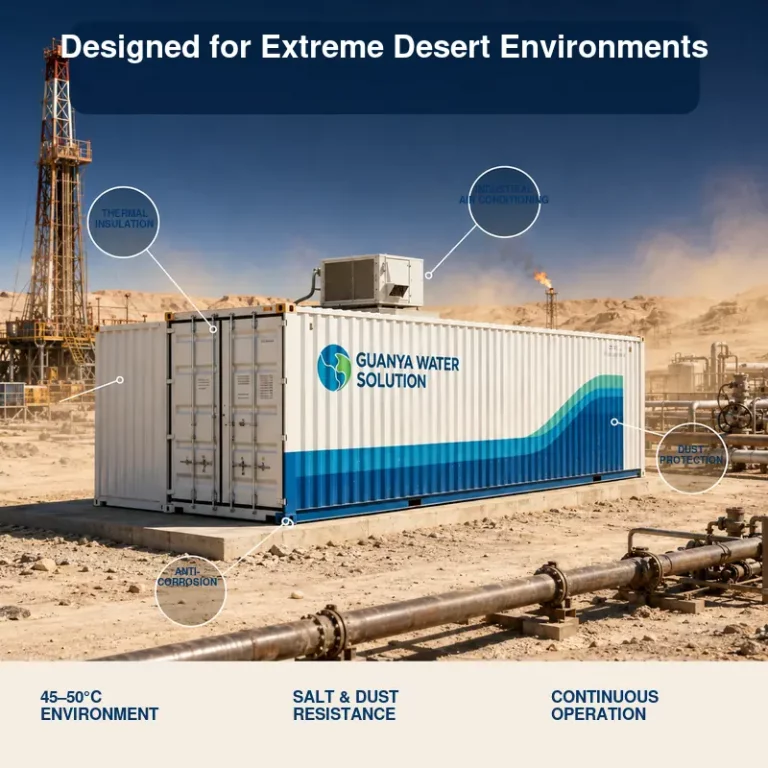
| High salt dust wind or freezing | Requires a suitable shelter supplied by the site | Enclosure can integrate insulation, ventilation or industrial HVAC |
| Access and crane limits | Smaller modules may be easier to move on mountain roads | Requires confirmed transport envelope, lifting plan and foundation |
| Installation labor | More external connections and shelter coordination | More factory integration and fewer site interfaces |
| Future expansion | Additional skids can be connected if utilities allow | Parallel containers provide repeatable modular expansion |
| Maintenance access | Open access is convenient | Internal clearance and component removal routes must be verified |
GUANYA preliminary mobile and containerized RO range
The following values are preliminary selection data from GUANYA specifications. Flow is nominal permeate capacity. Installed power is equipment nameplate power and is not the same as guaranteed average energy consumption. Panel quantities assume 720 W modules and provide an initial PV reference only. Final selection requires source-water analysis, altitude correction, operating hours, pretreatment design and an hourly power study.
| Model | Nominal permeate | Power and process | Preliminary solar reference | Container concept |
|---|---|---|---|---|
| GY-SW/4040-0.3 | 0.3 m³/h | 5 kW; 3.5–5.5 MPa; 30–35% recovery | 7 panels; 5.0 kWp; 21.7 m² | 20 ft option |
| GY-SW/4040-1 | 1 m³/h | 10 kW; 3.5–5.5 MPa; 30–35% recovery | 14 panels; 10.1 kWp; 43.5 m² | 20 ft option |
| GY-SW/8040-3 | 3 m³/h | 25 kW; 3.5–5.5 MPa; 30–35% recovery | 35 panels; 25.2 kWp; 108.7 m² | 20 ft option |
| GY-SW/8040-5 | 5 m³/h | 42 kW; 3.5–5.5 MPa; 30–35% recovery | 59 panels; 42.5 kWp; 183.3 m² | 20 ft HC concept |
| GY-SW/8040-15 | 15 m³/h | 120 kW; 3.5–5.5 MPa; 30–35% recovery | 167 panels; 120.2 kWp; 518.8 m² | 40 ft HC concept |
| GY-BW/4040/2-0.7 | 0.7 m³/h | 3 kW; 10–20 bar; 50–60% recovery | 5 panels; 3.6 kWp; 15.5 m² | 20 ft concept |
| GY-BW/4040/6-2 | 2 m³/h | 6 kW; 10–20 bar; 50–60% recovery | 9 panels; 6.5 kWp; 28.0 m² | 20 ft concept |
| GY-BW/8040-5 | 5 m³/h | 10 kW; 10–20 bar; 50–60% recovery | 14 panels; 10.1 kWp; 43.5 m² | 20 ft concept |
| GY-BW/8040-8 | 8 m³/h | 15 kW; 10–20 bar; 50–60% recovery | 21 panels; 15.1 kWp; 65.2 m² | 20 ft concept; detailed access check |
For the listed SWRO range, the preliminary feed basis is TDS below 40,000 mg/L, 5–45 °C and pH 7–8, with target permeate TDS up to 500 mg/L subject to analysis and final design. For BWRO, the preliminary feed basis is TDS below 10,000 mg/L under the same temperature and pH range, with target permeate TDS up to 300 mg/L. These are selection boundaries, not substitutes for a complete water-quality review.
What the solar panel count does and does not mean
For example, the GY-SW/8040-5 lists 42 kW installed power and 59 × 720 W panels, equivalent to about 42.5 kWp and 183.3 m² of panel area. This does not mean the plant can run continuously at 42 kW from that array. Actual PV output changes with irradiance, module temperature, dust, altitude, inverter efficiency and time of day. The generator, grid, batteries or water-storage strategy must close the hourly energy gap. The 5 m³/h BWRO reference is much lighter electrically at 10 kW, with 14 panels and about 43.5 m², which illustrates why identifying the real feed salinity is critical before discussing solar capacity.
Recommended hybrid architecture
- PV array sized from hourly solar and load modelling, not from daily energy totals alone.
- Mine microgrid or diesel generator retained as a stable source for start-up, transients, night operation and low-solar periods.
- Battery storage used selectively for ramp control, short interruptions or generator optimization; it is not automatically required for all-night RO operation.
- Variable-frequency drives and PLC logic that keep flow, pressure, recovery and membrane limits within the approved operating envelope.
- Treated-water storage sized to separate water demand from moment-to-moment solar output.
- Remote monitoring of flow, pressure, conductivity, tank level, energy use, alarms and generator status.
Information required before sizing
- Mine coordinates, elevation, ambient temperature range, dust, wind, snow and road or crane limitations.
- Source-water analysis including TDS or conductivity, temperature, pH, hardness, alkalinity, silica, iron, manganese, arsenic, sulfate, chloride, turbidity and SDI where applicable.
- Net water demand by hour and day, peak camp occupancy, process demand, required water quality and storage volume.
- Existing generator sizes, fuel consumption records, minimum stable loading, grid availability and electrical frequency and voltage.
- Hourly or bankable solar-resource data, available PV area, shading, cleaning strategy and connection boundary.
- Required autonomy, redundancy philosophy, critical-spares strategy and acceptable water-supply interruption.
- For seawater projects, intake, pretreatment, brine discharge and the elevation profile of any long-distance pipeline.
Frequently Asked Questions
Can solar panels run an RO plant directly at a high altitude mine?
Yes, but a mine-water system should normally use a controlled hybrid electrical architecture. Directly connecting variable PV output to the RO high-pressure pump without stable controls can push flow, pressure and recovery outside their safe ranges.
Does the system need batteries?
Not always. Water tanks, daytime production, the existing generator and the mine microgrid may provide enough flexibility. Batteries are justified when they improve ramp control, generator loading, short-term continuity or the overall business case.
How much diesel can a solar hybrid RO system save?
Savings depend on the verified RO load, solar yield, generator fuel curve, storage and dispatch strategy. A project-specific hourly model is required. The 100 m³/day example in this article illustrates the method but is not a guaranteed saving.
Is the equipment seawater RO or brackish water RO?
It depends on the source. SWRO is normally located near a seawater intake. High-altitude camps often use BWRO for saline groundwater. The membrane, pressure, recovery and pretreatment are different and must not be selected from capacity alone.
What must be changed for 4,000 m elevation?
Electrical equipment and generators require altitude checks; pump suction conditions need review; cooling margins, insulation, freeze protection, UV resistance, dust control and remote diagnostics should be specified for the site.
Which is better for exploration camps mobile or containerized RO?
A small mobile skid is easier to relocate and can suit temporary low-flow demand. A containerized plant provides better environmental protection and factory integration when the camp is larger or will remain for several years.
Can the RO system follow solar power during the day?
It can operate within an approved turndown range using VFDs and control logic. Frequent uncontrolled starts, stops or pressure changes should be avoided because stable pretreatment and membrane operation remain essential.
What data should be sent for a quotation?
Send water analysis, required net production, elevation, ambient conditions, power data, solar information, storage, site access, operating schedule and photos or drawings. For an existing plant, include pressures, flows, conductivity, energy use and maintenance history.
How GUANYA supports remote mining projects
Guangdong Guanya Environmental designs and manufactures mobile skid-mounted and containerized RO systems for mining camps, high-TDS groundwater, seawater desalination and water reuse. Systems can be configured with solar-grid-diesel hybrid interfaces, variable-frequency pumps, PLC/HMI control, remote monitoring, insulation, industrial air conditioning and high-altitude electrical selection according to project conditions.
GUANYA completes equipment assembly and factory acceptance testing before shipment and supplies process documentation, interface requirements and remote commissioning support. A technical proposal begins with the water source, elevation, hourly demand and available power rather than a standard equipment model.
Contact GUANYA to evaluate a mobile or containerized solar hybrid RO system for your mining project
Technical and Market References
- COCHILCO Water Demand in Chilean Copper Mining 2025 to 2034 https://www.cochilco.cl/web/informe-proyeccion-del-consumo-de-agua-en-la-mineria-del-cobre-2025-2034/
- COCHILCO Seawater share to reach 67.6 percent by 2034 https://www.cochilco.cl/web/https-www-cochilco-cl-web-download-1014-2026-15581-informe-proyeccion-de-la-demanda-de-agua-en-la-mineria-del-cobre-en-chile-periodo-2025-2034-pdf/
- Chile Ministry of Energy Atacama solar energy https://energia.gob.cl/node/157
- Gold Fields Salares Norte hybrid power system https://goldfields.com/in-the-news-article.php?articleID=11508
- Schneider Electric altitude derating guidance https://www.se.com/cl/es/faqs/FA324368/
- IEA PVPS O and M Guidelines for PV Systems https://pvpmc.sandia.gov/app/uploads/sites/243/dlm_uploads/2022/12/IEA-PVPS-Report-T13-25-2022-OandM-Guidelines.pdf