By GUANYA WATER SOLUTION
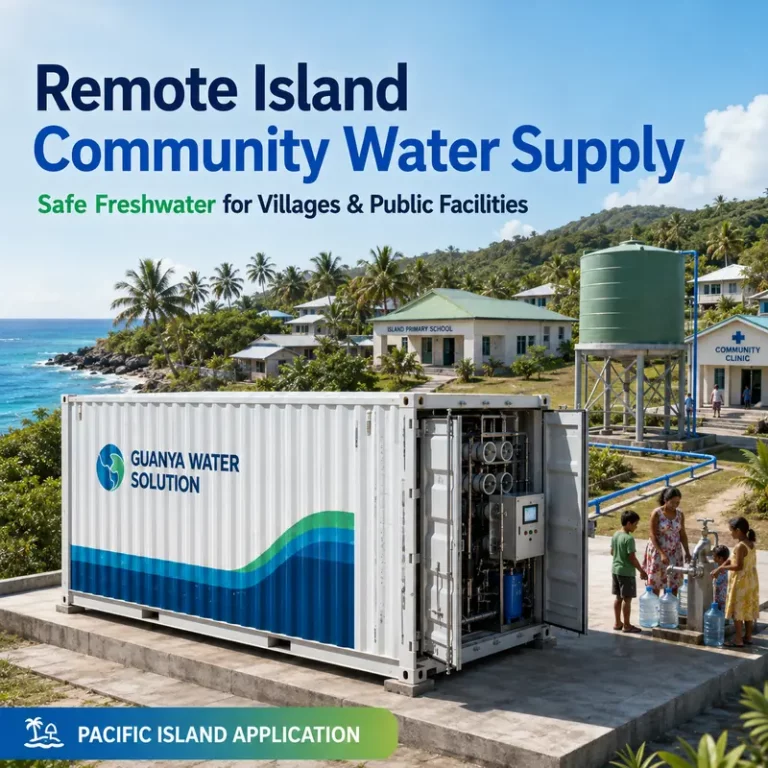
For an island or remote coastal site, the best desalination system is not simply the unit with the lowest purchase price. The decisive question is which configuration can be delivered, commissioned and maintained reliably when transport is difficult, skilled labor is limited and salt-laden air accelerates corrosion.
A containerized seawater reverse osmosis system is usually the stronger choice when rapid deployment, factory testing, compact installation and controlled integration matter most. A conventional skid-mounted or plant-room system can still be better when the site already has a suitable building, experienced operators, easy access to contractors and a layout that must remain open for frequent maintenance. The correct decision should be based on lifecycle risk, not the enclosure alone.
Quick answer
Choose a containerized SWRO plant when the project needs one integrated transportable package, minimum island assembly, documented factory acceptance testing and predictable interfaces. Choose a conventional skid-mounted system when local construction capability is strong, the plant room is already corrosion-controlled and the owner needs maximum freedom to expand or rearrange individual process sections.
Containerized vs conventional SWRO at a glance
| Decision factor | Containerized SWRO | Conventional skid or plant-room SWRO |
|---|---|---|
| Delivery | Integrated package shipped as one or several defined modules | Multiple skids, crates and site-installed connections |
| Site work | Mainly foundations, intake, power, product water and brine interfaces | More piping, cabling, alignment and coordination on site |
| Factory testing | A larger portion of the complete system can be wet-tested before shipment | Individual skids may be tested, but final integration happens on site |
| Marine exposure | Enclosure can protect equipment, but coating, ventilation and condensation control are essential | Open equipment is easier to access but needs a properly protected building |
| Maintenance | Compact and organized; access must be designed carefully | Generally more open access and more layout flexibility |
| Expansion | Modular capacity can be added, subject to shared intake and discharge limits | Process trains can be expanded more freely if space and utilities exist |
| Relocation | Designed for lifting and relocation if structural limits are respected | Relocation usually requires dismantling and re-piping |
| Initial cost | Often higher because enclosure and integration are included | May be lower if a suitable building and local contractors already exist |
| Lifecycle risk | Lower site-integration risk when scope and FAT are well defined | More dependent on local installation quality and interface management |
What is a containerized seawater reverse osmosis system
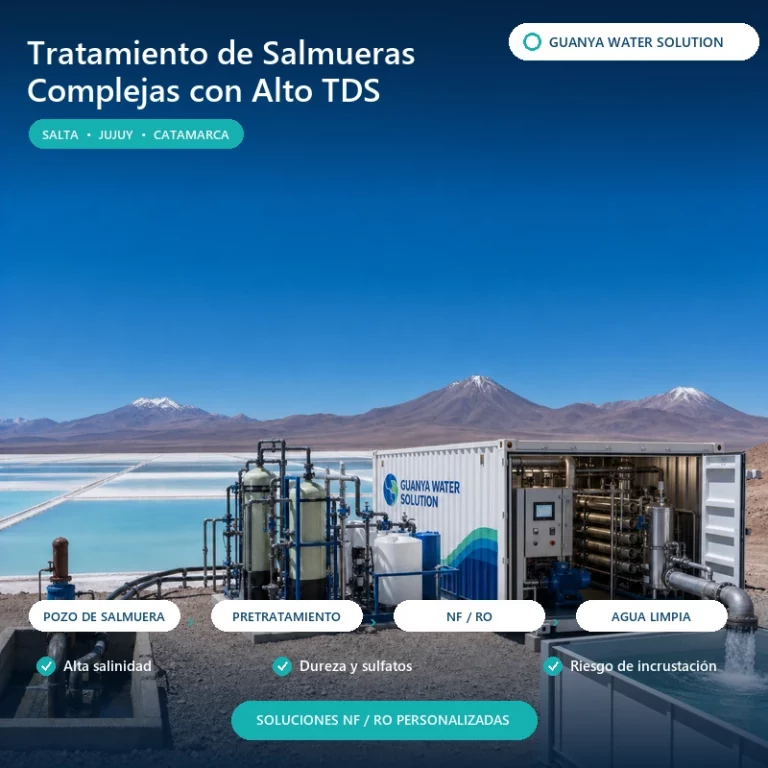
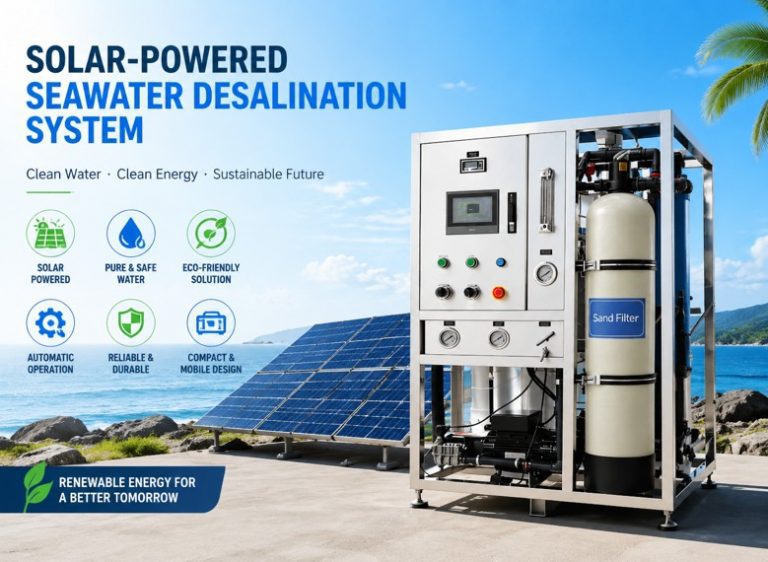
A containerized SWRO system places the main treatment equipment inside a modified 20-foot or 40-foot container. Depending on capacity and water quality, it may include feed pumping, pretreatment, cartridge filtration, high-pressure RO, energy recovery, chemical dosing, clean-in-place equipment, remineralization, disinfection and PLC or HMI controls. Larger plants may use separate containers for pretreatment, RO and post-treatment.
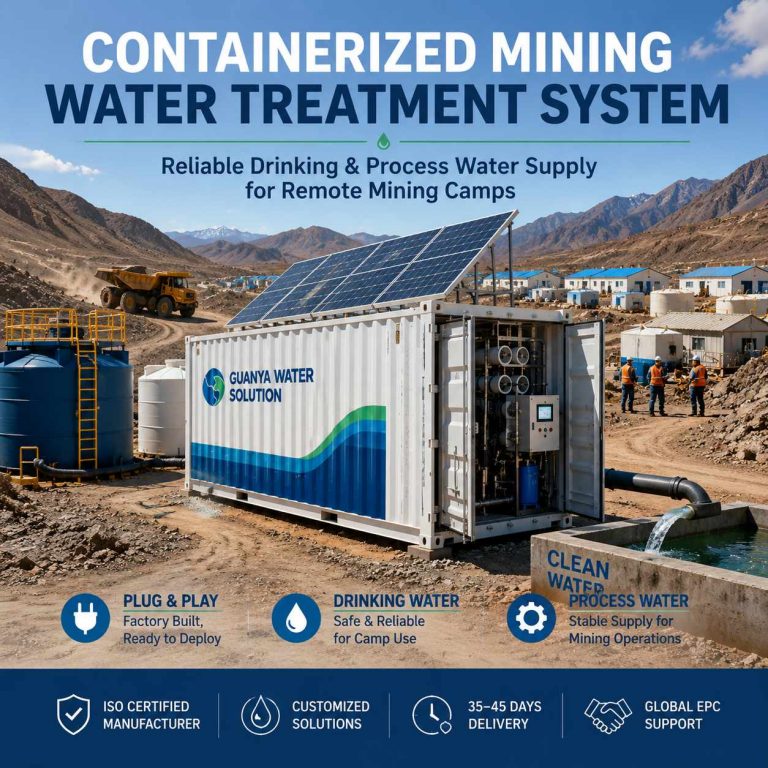
Containerized does not automatically mean truly plug-and-play. The project still needs an engineered seawater intake, screened feed supply, stable electrical power, foundations, product-water storage, brine discharge, drainage and local compliance. A good supplier defines every battery-limit connection before manufacturing.
Why island desalination projects are different
- Transport is a design constraint. Equipment may pass through small ports, barges, limited cranes and narrow island roads. Packaging and lifting plans should be engineered before production.
- Salt spray and humidity attack carbon steel, electrical terminals, sensors, fasteners and unprotected control boards. The container shell alone is not a corrosion strategy.
- A missing fitting or incompatible electrical component can stop commissioning for weeks because replacement parts are not locally available.
- Water demand can change sharply between low and high occupancy. Storage volume, redundancy and turndown capability matter as much as nominal daily capacity.
- Intake water changes with tides, storms, algae and turbidity. Pretreatment must be selected from real source-water data, not from salinity alone.
- When potable water is required, post-treatment, disinfection, monitoring and a site-specific water safety plan must be included.
Advantages of containerized seawater desalination
Faster and more predictable deployment. Process piping, electrical wiring and control logic can be assembled in the factory. Island work is reduced to civil preparation and clearly defined external connections.
More complete factory acceptance testing. A properly designed FAT can verify alarms, interlocks, pressure integrity, flow, conductivity and control sequences before shipment. Feed-water conditions during FAT must still be documented because final performance depends on actual seawater.
Fewer field interfaces. Reducing site-made joints and cross-trade coordination lowers the probability of leaks, wiring errors and incomplete installation.
Controlled equipment organization. A disciplined layout can separate wet areas, chemicals and electrical panels while keeping filters, pumps and membranes accessible.
Transportable and modular. The package can be relocated or supplemented with another treatment train, provided lifting, structural and shared utility limits are considered.
Remote operational visibility. PLC and HMI systems can record pressure, flow, conductivity, alarms and operating hours. Remote access should use secure network practices and must not replace trained local operation.
Disadvantages and design limits
Higher upfront cost. The enclosure, HVAC or ventilation, fire and chemical provisions, structural work and factory integration add cost. The comparison should include the plant room, island labor, supervision and commissioning risk of the alternative.
Restricted maintenance space. Poor layouts can make membrane removal, pump replacement or instrument calibration difficult. Buyers should request plan and elevation drawings that show service clearances and removal paths.
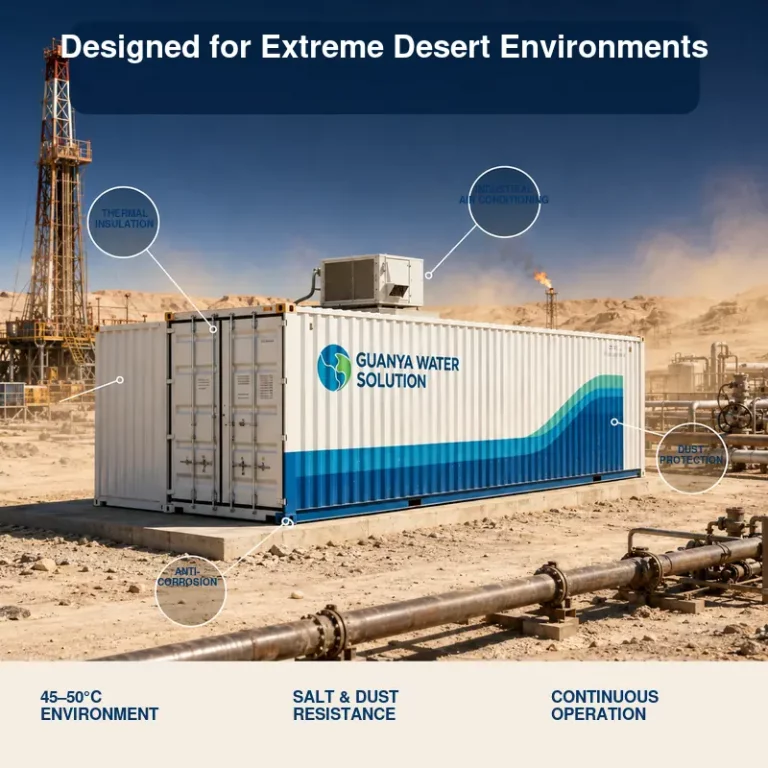
Heat and condensation risk. A sealed metal box in a tropical climate can overheat and sweat internally. Ventilation, insulation, air conditioning where required, drainage and condensation management must be sized for the actual climate and equipment heat load.
Corrosion is reduced, not eliminated. Appropriate coatings, stainless or duplex materials where justified, compatible fasteners, coated electrical boards, cable-gland protection and washdown practices remain necessary.
Transport envelope limits. Capacity, pretreatment complexity and maintenance access may require more than one container. Oversized equipment can remove the logistical advantage.
Not every site is plug-and-play. Intake, outfall, storage, distribution, electrical protection and permits remain site works. Any proposal that omits these interfaces is incomplete.
When a conventional skid-mounted SWRO system is the better option
A conventional system should not be dismissed as outdated. It may be preferable when the owner already has a dry, ventilated and corrosion-controlled plant room; local contractors can complete high-quality piping and electrical work; large components require open access; or the plant will be expanded in stages. Open skids also make visual inspection and heavy maintenance easier. The weakness is not the skid itself but an incomplete building, fragmented supply scope or poor site integration.
Should an old desalination plant be upgraded or replaced
An aging plant should be assessed component by component. Replacing membranes alone will not solve unstable pretreatment, corroded high-pressure piping, obsolete controls or repeated pressure-vessel leaks. Conversely, a sound intake, tanks, distribution network or building may still have substantial value.
| Condition found | Retrofit may be reasonable | Replacement is usually safer |
|---|---|---|
| Structure and piping | Frame and pressure piping pass inspection; corrosion is superficial | Deep corrosion, repeated leakage, unsafe repairs or uncertain pressure integrity |
| High-pressure pump | Efficient, serviceable and compatible with new duty point | Obsolete, inefficient, badly corroded or without available parts |
| Pressure vessels | Traceable model, sound surfaces and serviceable end closures | Cracks, recurring end-cap leaks, unknown history or incompatible components |
| Controls | Panel can accept new sensors, alarms and secure remote monitoring | Unsupported PLC, damaged wiring or no room for safe upgrade |
| Pretreatment | Stable SDI and turbidity performance across seasonal conditions | Frequent fouling, algae or turbidity excursions and no upgrade space |
| Site integration | Existing intake, tanks, building and discharge remain suitable | Major civil, electrical and process interfaces all require rebuilding |
A practical retrofit decision process
- Collect at least seasonal feed-water data: salinity or conductivity, temperature, turbidity, SDI where available, pH, hardness, alkalinity, silica, iron, manganese, organics, oil and microbiological or algae risk.
- Record actual production, permeate conductivity, pressure, recovery, energy use, cleaning frequency, membrane age, leaks, alarms and downtime.
- Inspect the intake, pressure vessels, high-pressure piping, pumps, electrical panel, sensors, tanks and brine discharge. Pressure-containing equipment should be assessed by qualified personnel.
- Compare three scopes on the same boundary: repair only, partial retrofit and full replacement. Include island freight, cranes, accommodation, shutdown water supply, commissioning and spare parts.
- Select the option with the lowest acceptable lifecycle risk, not merely the lowest equipment price.
Technical specification checklist for island buyers
- Guaranteed net permeate capacity at the specified seawater salinity and temperature, not only nominal membrane output.
- Design recovery, expected permeate quality and the required drinking-water or process-water standard.
- Pretreatment basis and limits for feed turbidity, SDI, algae, oil and oxidants.
- Materials for high-pressure piping, low-pressure piping, frames, fasteners, instruments and the container coating system.
- Ventilation or HVAC heat-load calculation, insulation, drainage, lighting and chemical-fume management.
- Energy consumption basis and whether an energy recovery device is technically and economically appropriate for the selected capacity.
- Maintenance clearances, membrane removal route, lifting points and replacement path for the largest pump or motor.
- FAT protocol with recorded flow, conductivity, pressure, alarms and interlocks; define the test water and correction method.
- PLC and HMI functions, trend storage, alarm history, remote support method and cybersecurity responsibility.
- Commissioning boundary, operator training, manuals, drawings, recommended two-year consumables and critical spare parts.
- External interfaces: intake, outfall, foundation, power, product tank, distribution, chemicals, permits and local laboratory testing.
Frequently Asked Questions
Is a containerized desalination plant really plug-and-play?
It can greatly reduce site assembly, but it still requires a suitable intake, power supply, foundation, product-water connection, brine discharge and commissioning checks. “Plug-and-play” should describe a clearly integrated scope, not the absence of site engineering.
Does a container prevent corrosion?
No. It reduces direct exposure, but tropical humidity, condensation and salt carried through ventilation openings can still cause corrosion. Coatings, material selection, ventilation, drainage and routine washdown remain important.
Is a 20-foot or 40-foot container better?
The answer depends on net capacity, pretreatment, redundancy, energy recovery, maintenance clearance and transport limits. A 20-foot unit is easier to position, while a 40-foot unit provides more process and service space. Capacity alone should not determine the enclosure size.
Can an old SWRO plant be upgraded instead of replaced?
Yes, when the intake, structure, pressure vessels, piping and major rotating equipment remain safe and compatible. If corrosion, leaks, obsolete controls and weak pretreatment affect several systems, full replacement may carry less lifecycle risk.
What information is needed for an accurate quotation?
Provide required net water production, hourly demand profile, seawater analysis and temperature range, intake concept, product-water target, site power, available space, access and crane limits, storage arrangement, discharge requirements and photos or drawings of existing infrastructure.
How should potable water quality be handled?
The system should be designed around applicable local regulations and a water-safety approach. RO is normally followed by appropriate remineralization, pH adjustment and disinfection, with monitoring and verification defined for the site.
What should be included in factory acceptance testing?
The FAT should verify mechanical completion, pressure integrity, electrical safety, alarms, interlocks, automatic sequences and recorded operating data. Performance interpretation must state the feed-water composition and temperature used during testing.
How do island owners reduce downtime?
Use realistic storage, duty and standby philosophy, critical spares, remote diagnostics, trained local operators and documented response procedures. Redundancy should focus on components whose failure would stop water production and whose replacement lead time is long.
How GUANYA supports island and remote-water projects
Guangdong Guanya Environmental designs and manufactures containerized and skid-mounted seawater RO systems for islands, resorts, marine facilities and remote sites. Systems can be configured with pretreatment, energy recovery, CIP, remineralization, disinfection, PLC/HMI control, remote support, insulation and climate-control options according to the project conditions. Equipment is assembled and factory-tested before delivery, with project drawings, operating documentation and interface requirements supplied for site coordination.
For a new system or an aging SWRO upgrade, send the required capacity, seawater analysis, site photos, power supply, access limitations and existing process information. GUANYA can compare retrofit and replacement boundaries before a technical proposal is prepared.
Contact GUANYA to review your island desalination project
Technical References
- World Health Organization, Safe drinking-water from desalination https://www.who.int/publications/i/item/WHO-HSE-WSH-11.03
- DuPont FilmTec RO and NF Technical Manual https://www.dupont.com/content/dam/dupont/amer/us/en/water-solutions/public/documents/en/RO-NF-FilmTec-Manual-45-D01504-en.pdf
- U.S. Department of Energy, Reverse Osmosis https://www.energy.gov/node/757281
- Danfoss, Containerized SWRO desalination plants https://www.danfoss.com/en-us/industries/water-and-wastewater/dcs/seawater-containerized-desalination-plant-swro-reverse-osmosis-system/