
1. Engineered for Harsh Marine Environments
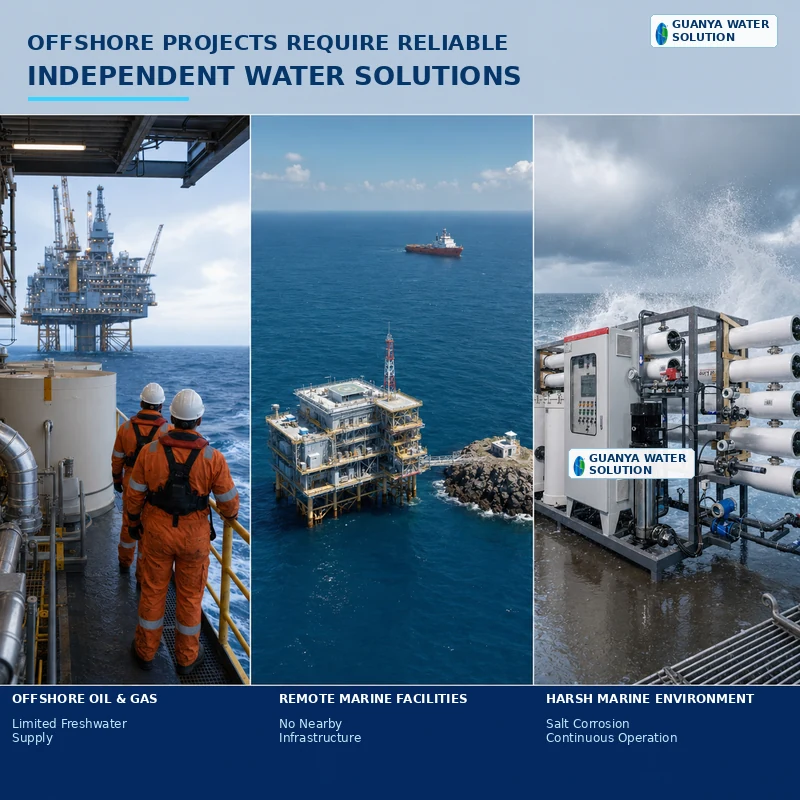
Our systems are built with 316L stainless steel, super duplex stainless steel, and FRP materials throughout — delivering complete resistance to pitting, crevice corrosion, and stress corrosion cracking in high-salinity, humid offshore atmospheres, ensuring reliable long-term operation of 15–20 years.
2. High-Capacity Production for Large-Scale Offshore Demand
With output ranging from 100 to 1,000 m³ per day, our systems are purpose-designed to meet the substantial freshwater needs of offshore oil platforms, FPSO vessels, wind farm substations, marine construction bases, and large-scale aquaculture facilities — delivering consistent, uninterrupted supply around the clock.
3. Containerized & Skid-Mounted Design for Rapid Deployment
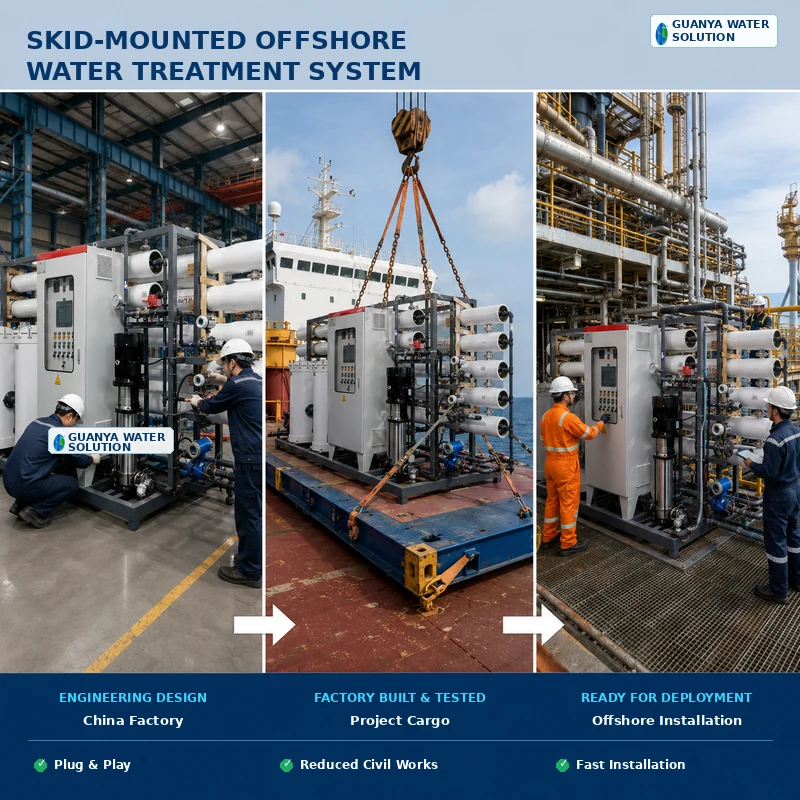
Built to standard ISO container dimensions, our systems ship and lift like regular cargo — arriving on-site fully pre-assembled, pre-piped, and pre-wired. Installation requires only utility hookups and a flat surface, cutting offshore commissioning time from weeks to just days, with zero complex civil construction.
4. Intelligent Automation with Remote Offshore Supervision
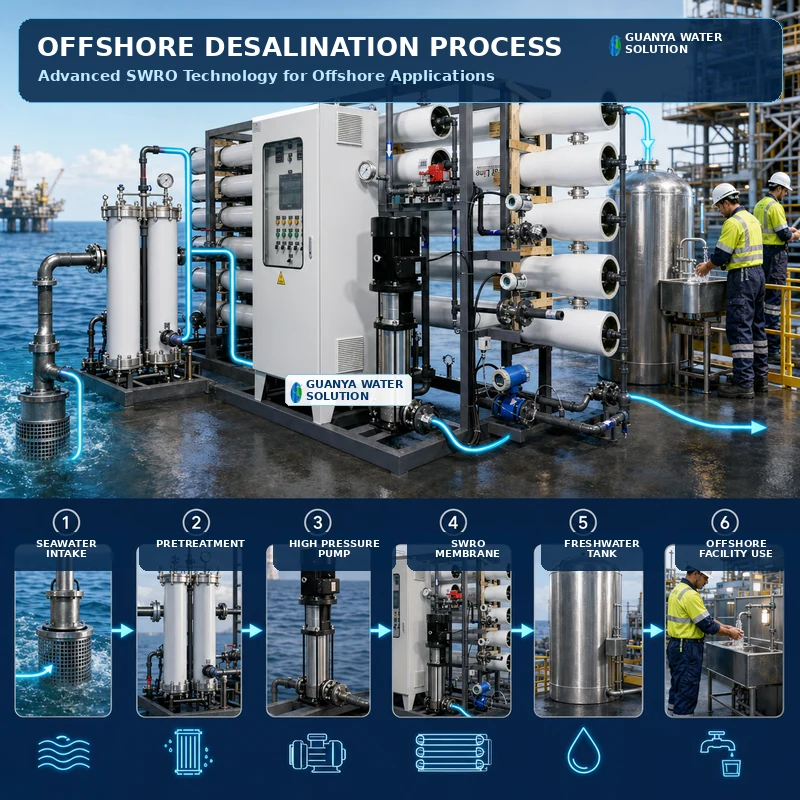
Our PLC-based control system with HMI interface enables fully automatic start/stop, real-time performance monitoring, fault diagnostics, and alarm management. With optional SCADA integration, offshore platforms can transmit operational data to onshore control centers for remote supervision — minimizing the need for on-site technical personnel.
5. Energy-Efficient Operation with Proven Cost Savings
An optional pressure exchanger-type energy recovery device (≥ 95% efficiency) captures hydraulic energy from the brine stream, significantly reducing specific power consumption. Combined with our China-manufacturing cost advantage, this delivers lower capital investment and reduced operating expenses compared with European suppliers — typically 30%–40% savings on equipment cost with equivalent performance and quality.
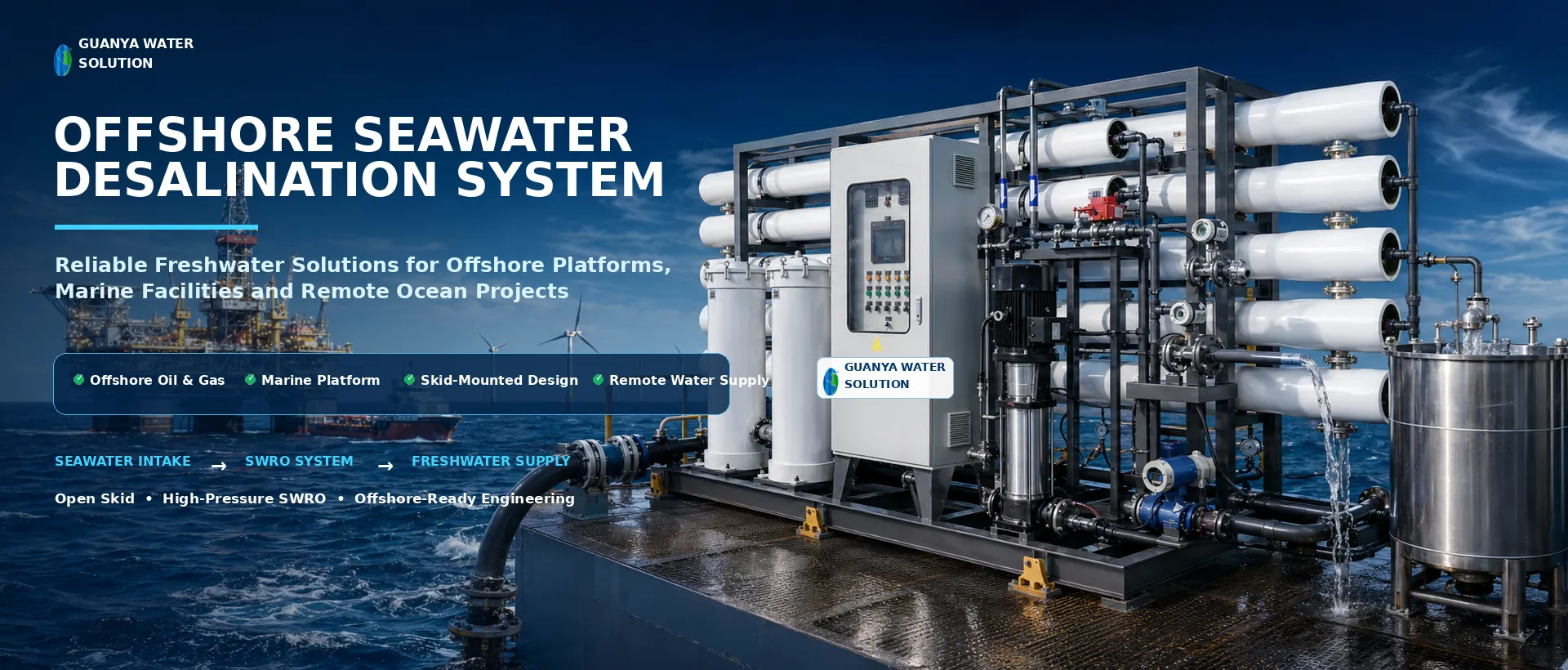
Reliable Freshwater Solutions for Offshore Oil & Gas, Marine Facilities and Remote Ocean Applications
100 – 5,000 m³/day high-capacity freshwater production
Containerized & skid-mounted modular design for rapid offshore installation
Corrosion-resistant materials (316L stainless steel, FRP, super duplex) built for high-salinity marine environments
PLC-based fully automatic control with SCADA remote monitoring capability
Optional energy recovery device (PX-type) with ≥ 95% efficiency for reduced operational costs
If you are considering an RO unit, contact us for an economical water treatment solution today
Engineered Specifically for Harsh Marine Environments – Five Core Strengths
Superior Corrosion Resistance for Long-Term Offshore Service – All high-pressure piping is fabricated from 316L stainless steel or super duplex stainless steel (PREN > 41), while membrane housings are constructed from FRP materials, providing complete immunity to pitting corrosion and stress corrosion cracking in high-salinity, humid marine atmospheres.
High-Capacity Freshwater Production to Meet Large-Scale Demand – With output ranges from 100 to 1,000 m³ per day, our systems are purpose-built for offshore platforms, FPSO vessels, and large marine facilities where consistent, high-volume water supply is mission-critical.
Containerized & Skid-Mounted Modular Design for Rapid Offshore Deployment – Built to standard ISO container dimensions, our systems are easily transportable and crane-liftable, requiring minimal site preparation and eliminating complex on-site civil construction — significantly reducing installation time and cost.
Intelligent Automation with Remote Monitoring Capability – Equipped with PLC-based control and an intuitive HMI touchscreen interface, the system supports fully automatic start/stop, fault diagnostics, and SCADA-ready data acquisition, enabling unattended operation and remote supervision — a critical advantage for offshore sites with limited manpower.
Energy-Efficient Operation with Optional Power Recovery – An optional pressure exchanger-type energy recovery device (≥ 95% efficiency) can be integrated to capture hydraulic energy from the brine stream, reducing specific energy consumption and substantially lowering long-term operating expenses.
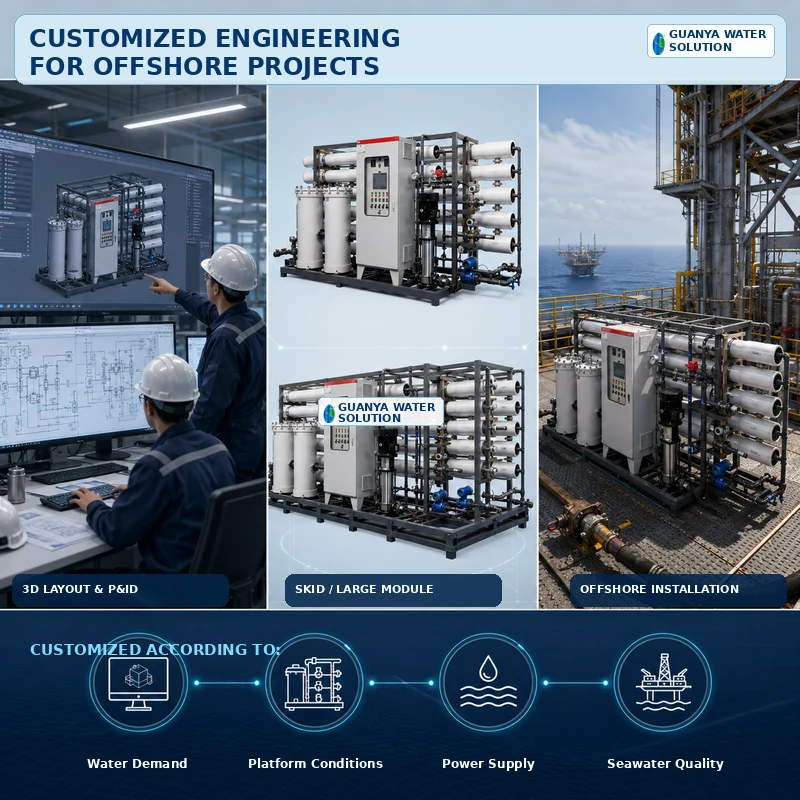
China Manufacturing – Cost-Effective Without Compromising Quality
Compared with traditional European large-scale desalination equipment suppliers, Guanya delivers clear competitive advantages:
| Comparison Factor | Guanya Advantage |
|---|---|
| Capital Investment | 30% – 40% lower than comparable European products, delivering equivalent performance at a significantly reduced cost |
| Customization Flexibility | Full acceptance of non-standard customizations — accommodating special water quality, dimensions, and material specifications |
| Delivery Cycle | 35 – 45 days from design confirmation to FAT completion and shipment readiness |
| Communication Efficiency | Direct, barrier-free access to our factory engineering team — no intermediaries, faster decision-making, clearer technical alignment |
End-to-End Service Package:
Water Quality Analysis → System Design & Engineering → Factory Manufacturing → FAT Testing → Global Logistics & Export Packing → Installation Guidance → On-Site Commissioning Support → Operator Training & Long-Term After-Sales Support
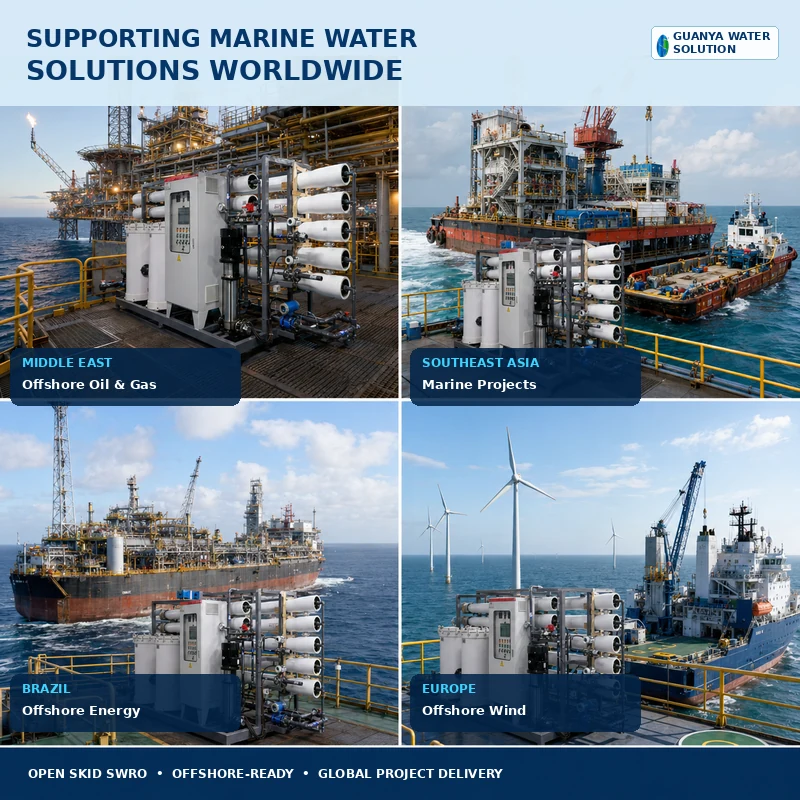
Who We Serve – Offshore & Marine Industries
| Application Sector | Typical Scenarios | Water Demand |
|---|---|---|
| Offshore Oil & Gas | Production platforms, FPSO units, drilling rigs | Crew drinking water, utility water, equipment cooling |
| Offshore Wind Farms | Wind turbine platforms, substation platforms | Long-term crew accommodation supply |
| Marine Construction | Pile-driving platforms, construction vessels, offshore work bases | Worker living water, equipment commissioning |
| Offshore Aquaculture | Fish farming bases, marine ranches | Water exchange, staff domestic use |
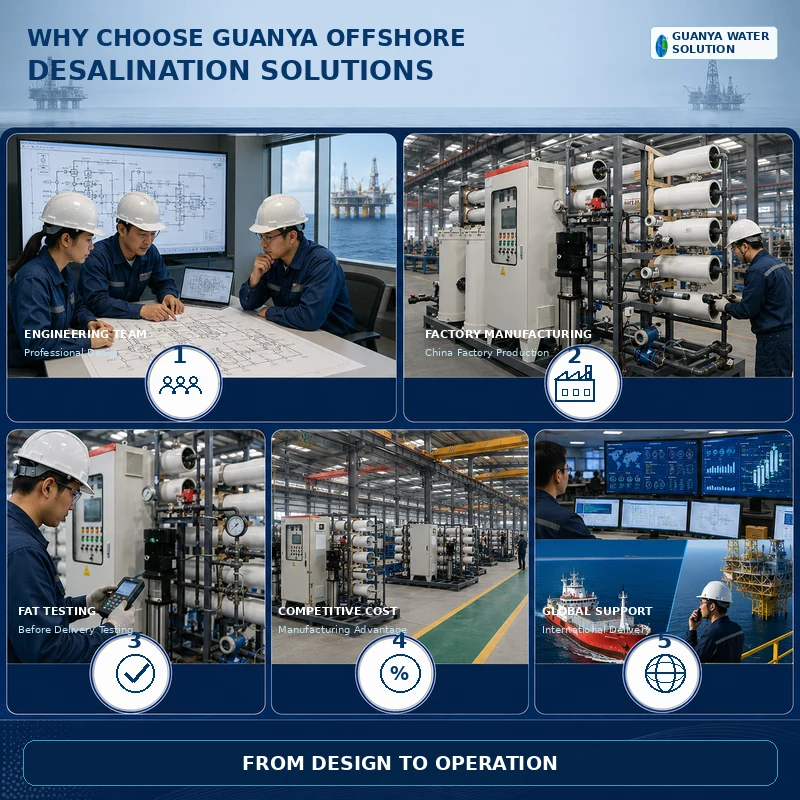
From Engineering Design to Final Delivery – Full In-House Capability
Unlike trading companies or intermediaries, Guanya delivers complete project execution — all under one roof, from water analysis and system design to manufacturing, FAT testing, and global logistics.
Our Engineering Team – Tailored Solutions for Every Project
Before production begins, our engineers conduct a comprehensive assessment covering:
Feed water quality (TDS, turbidity, organic and microbiological content)
Required production capacity and end-use application (potable / industrial / utility)
Platform installation constraints (space limitations, load capacity, ambient temperature)
Energy supply options (grid power, diesel generator, hybrid renewables)
Based on these findings, we match the optimal reverse osmosis process and system configuration to your specific operational profile.
In-House Manufacturing – Full Quality Control
Engineering Design → Equipment Fabrication → Pipeline Integration → Electrical Assembly → System Testing — all critical stages are completed at our own factory, ensuring complete quality traceability.
Factory Acceptance Testing (FAT) – Tested Before Shipment
Every system undergoes full wet-commissioning integrated testing prior to shipment — verifying equipment operation, pump performance, control system response, and overall operational stability. Clients are welcome to attend on-site or witness remotely via live video.
SEO keywords embedded: China Offshore Water Treatment Manufacturer, Custom Marine Desalination System, Factory Acceptance Test
Engineered Specifically for Harsh Marine Environments – Five Core Strengths
Superior Corrosion Resistance for Long-Term Offshore Service – All high-pressure piping is fabricated from 316L stainless steel or super duplex stainless steel (PREN > 41), while membrane housings are constructed from FRP materials, providing complete immunity to pitting corrosion and stress corrosion cracking in high-salinity, humid marine atmospheres.
High-Capacity Freshwater Production to Meet Large-Scale Demand – With output ranges from 100 to 1,000 m³ per day, our systems are purpose-built for offshore platforms, FPSO vessels, and large marine facilities where consistent, high-volume water supply is mission-critical.
Containerized & Skid-Mounted Modular Design for Rapid Offshore Deployment – Built to standard ISO container dimensions, our systems are easily transportable and crane-liftable, requiring minimal site preparation and eliminating complex on-site civil construction — significantly reducing installation time and cost.
Intelligent Automation with Remote Monitoring Capability – Equipped with PLC-based control and an intuitive HMI touchscreen interface, the system supports fully automatic start/stop, fault diagnostics, and SCADA-ready data acquisition, enabling unattended operation and remote supervision — a critical advantage for offshore sites with limited manpower.
Energy-Efficient Operation with Optional Power Recovery – An optional pressure exchanger-type energy recovery device (≥ 95% efficiency) can be integrated to capture hydraulic energy from the brine stream, reducing specific energy consumption and substantially lowering long-term operating expenses.
1. What is the typical lifespan of an offshore seawater desalination system?
With proper operation and routine maintenance, our offshore RO systems are designed for a service life of 15–20 years. Key components such as SWRO membrane elements typically require replacement every 3–5 years, depending on feed water quality, pretreatment efficiency, and operating conditions. All pressure vessels, piping, and structural components are fabricated from corrosion-resistant materials specifically selected for long-term marine service.
2. How does the containerized design benefit offshore installation?
The ISO container footprint allows for standardized shipping, simplified crane lifting, and rapid on-site positioning. Unlike traditional desalination plants that require extensive civil works and on-site assembly, our containerized system arrives fully pre-assembled, pre-piped, and pre-wired — reducing offshore installation time from weeks to just a few days and minimizing costly vessel or crane standby time.
3. Can the system operate automatically with minimal on-site personnel?
Absolutely. Our PLC-based control system with HMI touchscreen supports fully automatic start/stop, real-time process monitoring, fault diagnostics, and alarm notification. With the optional SCADA interface, operation and performance data can be transmitted to onshore control centers for remote supervision. Offshore platforms typically require only one trained operator for routine checks and basic maintenance.
4. What capacity range do you offer for offshore applications?
We offer systems ranging from 100 to 1,000 m³/day in single-container or multi-container configurations, with higher capacities available upon request through parallel system integration. The exact capacity is tailored to your platform’s daily water demand, occupancy, and application requirements — whether for potable drinking water, utility supply, or process use.
5. What about spare parts and after-sales support for remote offshore sites?
We provide a recommended spare parts kit with every system, covering critical consumables such as membrane elements, seals, O-rings, cartridge filters, and spare instrument sensors. Additionally, we offer remote troubleshooting via video call or data link, and our service team can be deployed for on-site maintenance when required. All systems are also supplied with a comprehensive operation and maintenance manual.
6. Can the system be customized to fit limited platform space?
Yes. Our engineering team works closely with your platform layout to design a space-optimized configuration, including split-skid designs, vertical arrangements, or distributed modular layouts — all while ensuring full accessibility for operation and maintenance. We routinely customize systems for platforms where available footprint is measured in square meters, not square feet.
7. What certifications do your systems hold?
Our systems are manufactured in accordance with ISO 9001 (Quality Management) , ISO 14001 (Environmental Management) , and are available with CE certification upon request. All pressure components are designed and tested to international standards, and our FAT protocol ensures every system meets or exceeds specified performance criteria before shipment.
8. How do I get started with a custom offshore system?
Simply reach out via the inquiry form below with your basic project information — including target capacity, application type, and site conditions. Our technical team will contact you within 24 hours to discuss your requirements and provide a preliminary solution and budget estimate tailored to your project.