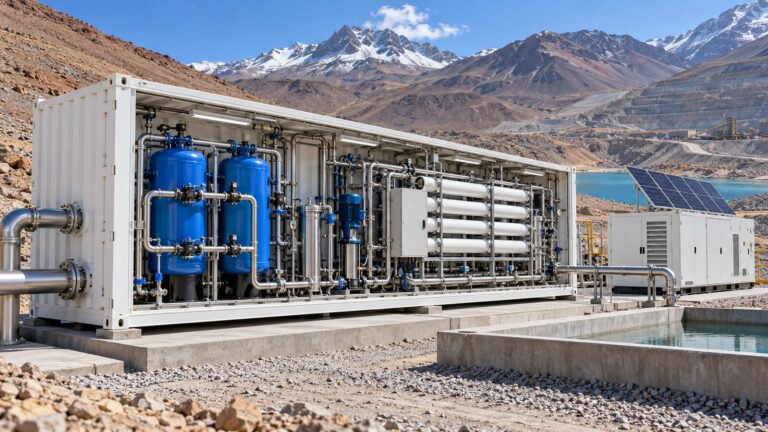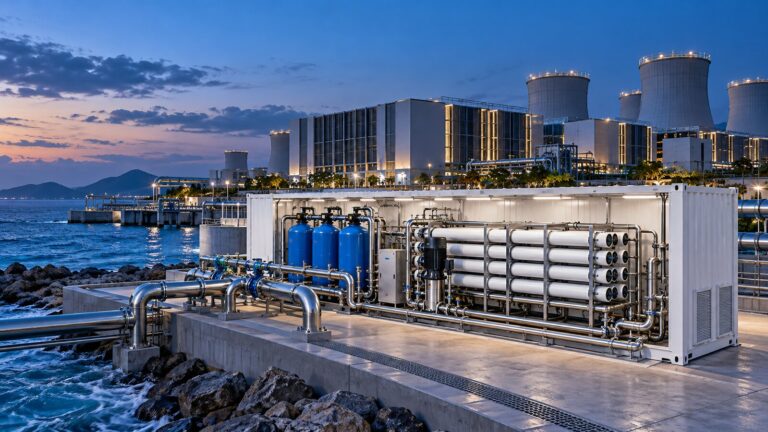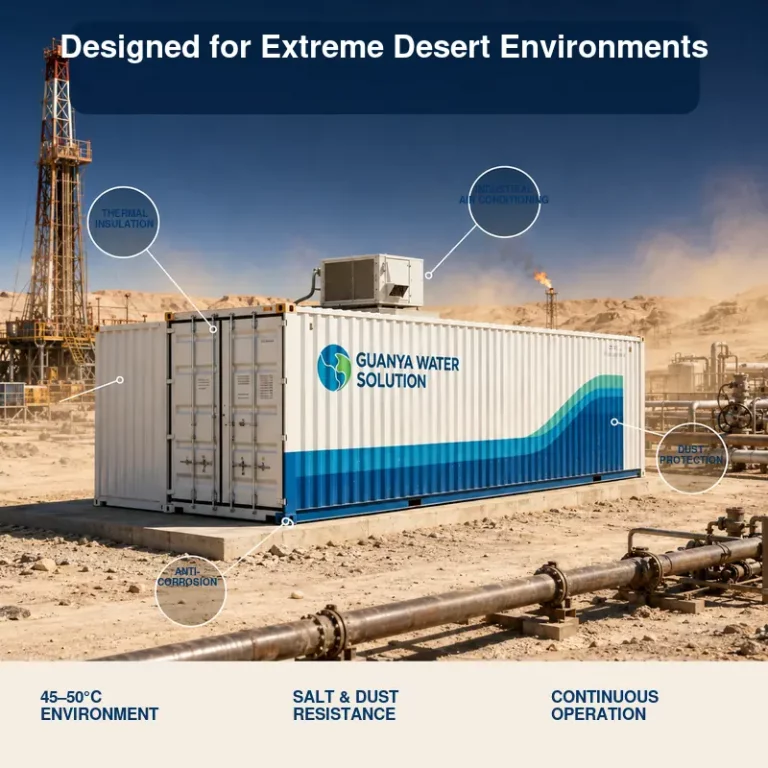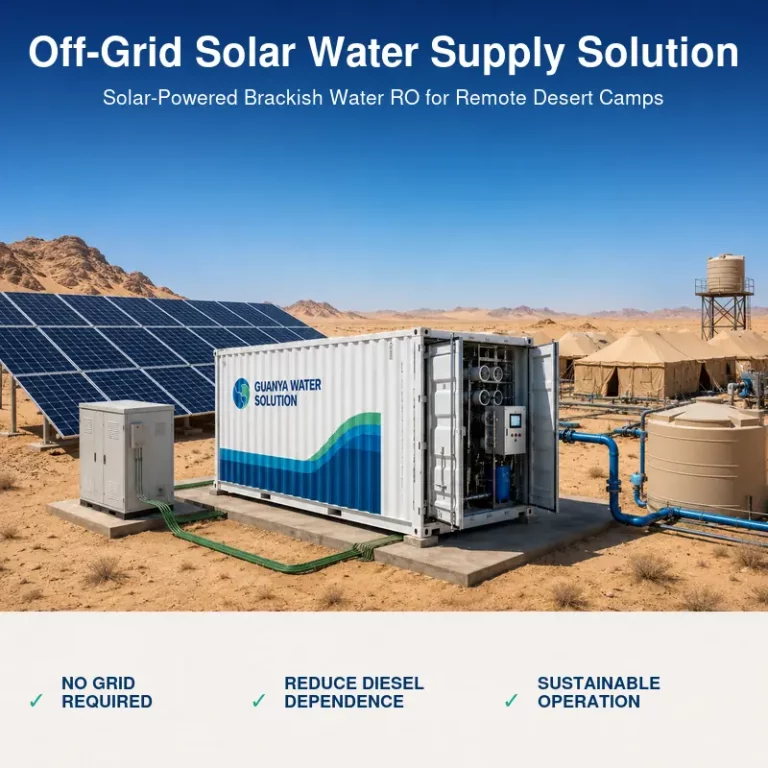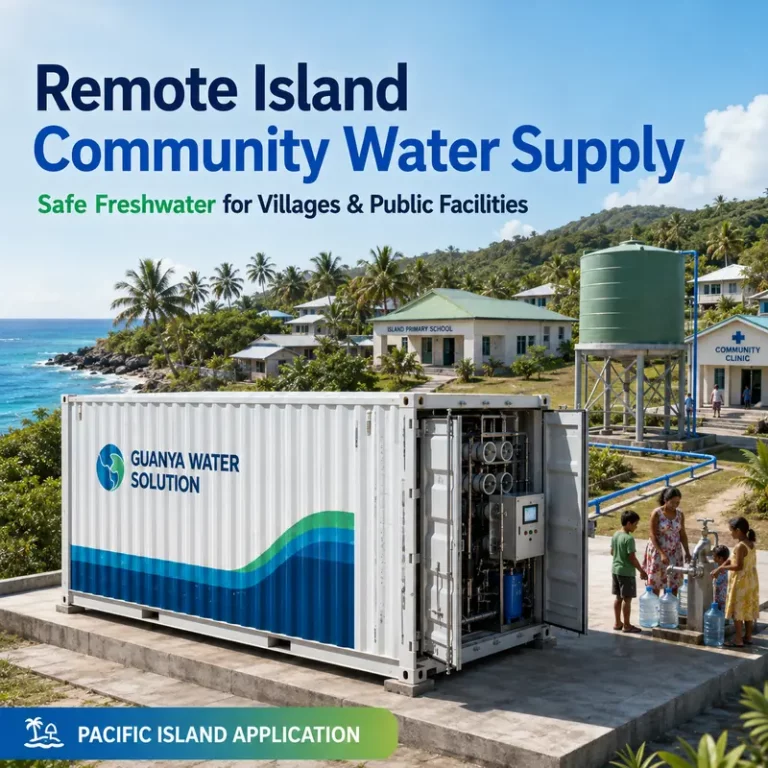
When a containerized or skid-mounted seawater reverse-osmosis (SWRO) plant leaves the factory, most of the process assembly should already be complete. What happens next is not a field-build of loose components. It is a supervised hand-over: the plant is tested in the factory, shipped as an integrated module, connected to the owner’s water and power interfaces, and started according to the same sequence used in the factory test.
This article describes GUANYA WATER SOLUTION’s standard approach. Project-specific FAT programs are issued with the detailed engineering documents. It does not promise a fixed number of hours from arrival to first water. That time depends on site interfaces, lifting, feed quality and the owner’s civil and electrical readiness.
What factory acceptance includes
FAT is planned, witnessed and recorded before shipment. A typical program is organized as follows.
Preparation. GUANYA issues an approved FAT procedure together with the process flow diagram, general-arrangement and container layout drawings, equipment list and data sheets, I/O list, and instrument calibration certificates. The client reviews this pack.
Witness rules. Hold points (H) do not proceed without written witness consent. Witness points (W) may be attended after notice. Review points (R) are closed on documents. Failures go to a punch list and are re-inspected after rectification.
Standard stages
- Documentation review — FAT procedure, process description, drawings, bill of materials, data sheets, single-line diagram, control schematics, I/O and control description, motor and load list, material certificates, and the RO membrane design basis.
- Static inspection — configuration against scope; tags and nameplates; bilingual or English equipment labels as specified; fabrication quality and cleanliness; dimensions and maintenance clearance; skid alignment; welding and surface treatment; vessel and housing checks; supports and vibration damping; flow, medium and hazard labels.
- Quantity and nameplate verification — quantities, models, ratings, materials and serial numbers against the approved supply list and data sheets.
- Pressure and leak test (hold point) — hydrostatic pressure and leak test of skid piping at the approved test pressure, with no visible leakage, deformation or unacceptable pressure drop.
- Functional tests — pump rotation and run; automatic filter cycles; dosing-system calibration; valve actuation and feedback; PLC/HMI functions; interlocks and protections (including dry-run, high/low pressure and level); alarms.
- Performance test, when scheduled (hold point) — flow, pressure, recovery and product quality (conductivity / TDS) at the agreed test conditions, for the duration in the approved procedure. Not every contract schedules a full performance run on seawater in the factory; the project FAT procedure states what will be demonstrated.
- Final review and release (hold point) — open items, release conditions, and signatures of GUANYA, the client and, where appointed, the end user or a third-party inspector.
Each FAT is documented item by item (status, actual result, evidence, inspector and date). A test video is shared with the client before shipment, together with the English operation and maintenance manual, process drawings, electrical documentation, equipment schedule and packing list.
What arrives as an integrated module
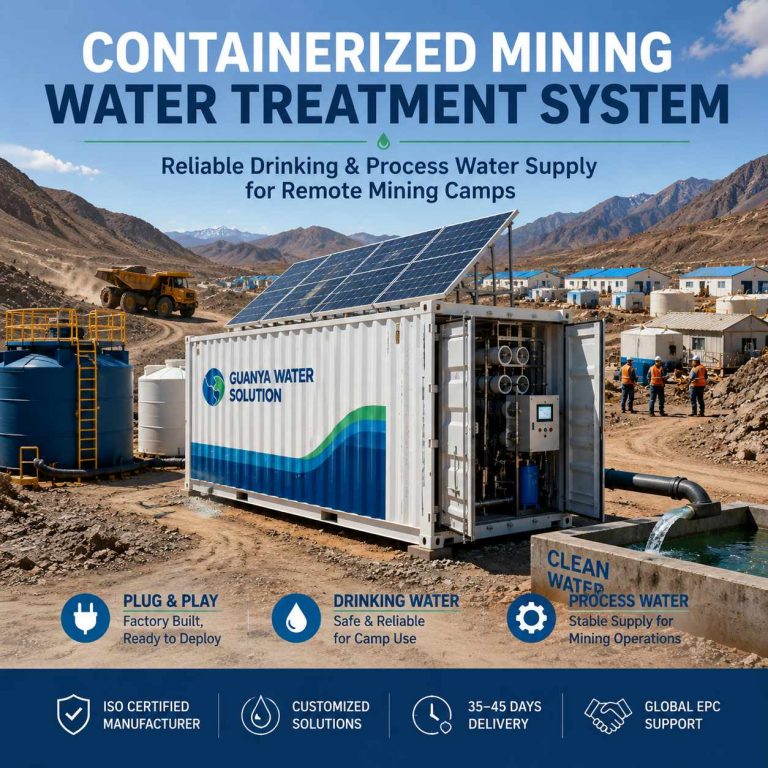
The standard delivery concept is factory-assembled and factory-tested modules, not a loose-component shipment for field assembly. Internal process piping, valves, instruments, electrical panels and internal cables are connected and checked before dispatch. Operator-facing controls and required equipment identification are labelled in English. The same principle applies to a non-containerized skid supply: the treatment skids are assembled and FAT-tested at the factory before dispatch.
What the owner provides on site
After delivery, site start-up depends on interfaces that usually sit outside the container or skid. Unless a contract says otherwise, the owner (or the owner’s civil and electrical contractors) provides:
- lifting, placement on flat, load-bearing ground, and any local shelter required by the site
- incoming electrical supply, at the voltage and frequency confirmed in the project documents
- raw-water intake works and the raw-water tank or feed arrangement specified for the plant
- product-water piping to the owner’s storage
- concentrate / drain piping to the owner’s approved discharge point
- qualified operating personnel
Once the module is connected to the approved water and power interfaces, it is started in accordance with the FAT-proven sequence and the English operating documents. For many compact plants the raw-water tank must be able to supply the feed pump as described in the plant manual (some smaller units are designed for gravity supply to the raw-water pump inlet). Larger plants follow the project hook-up drawings.
A detailed start-up procedure typically covers: confirming that power and feedwater are available; filling internal pipework before automatic operation; switching from manual to automatic mode; automatic membrane flushing at start-up; and only then normal production. Pretreatment filters are rinsed and backwashed as specified in the plant manual.
Optional on-site services
Physical attendance for installation supervision, on-site commissioning, operator training and periodic inspections is not automatically included in a factory-integrated equipment supply. Those services can be arranged later if requested, after scope, dates, access, travel and accommodation have been agreed. Remote video guidance for start-up readiness, operating questions and fault diagnosis is part of the standard support model described in a companion article.
Why this article does not quote a fixed “hours to water”
Arrival, hook-up and first water are different events. Factory integration and FAT shorten field work, but they do not replace site connections, lifting, or a suitable feed. GUANYA therefore does not use a fixed number of hours as a public start-up promise. The reliable statement is: the plant is assembled and tested in the factory; after the approved interfaces are connected, it is started according to the documented sequence.
For a project-specific FAT procedure or a hook-up checklist, contact GUANYA WATER SOLUTION with the system reference or the feed-water and site-interface data. Related pages: spare parts and consumables; remote support; chemical dosing and CIP; seawater intake and brine discharge.