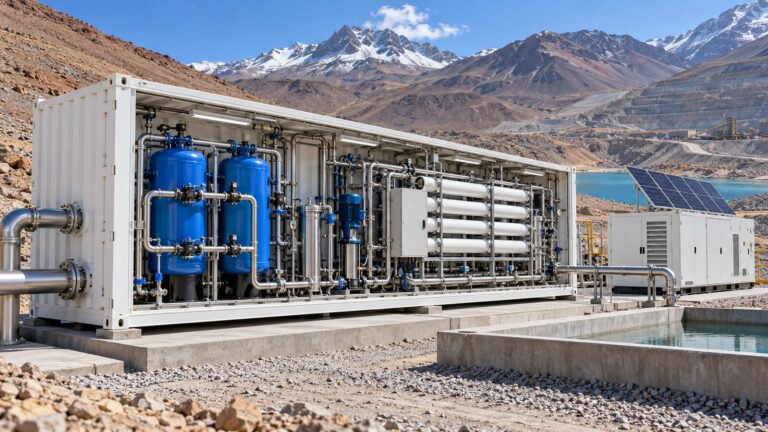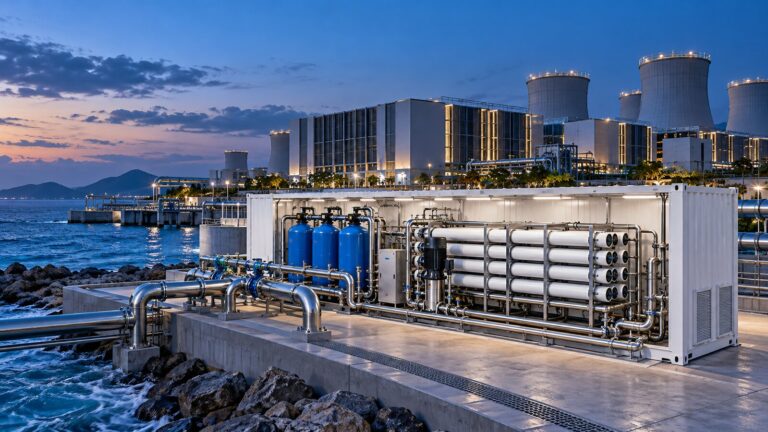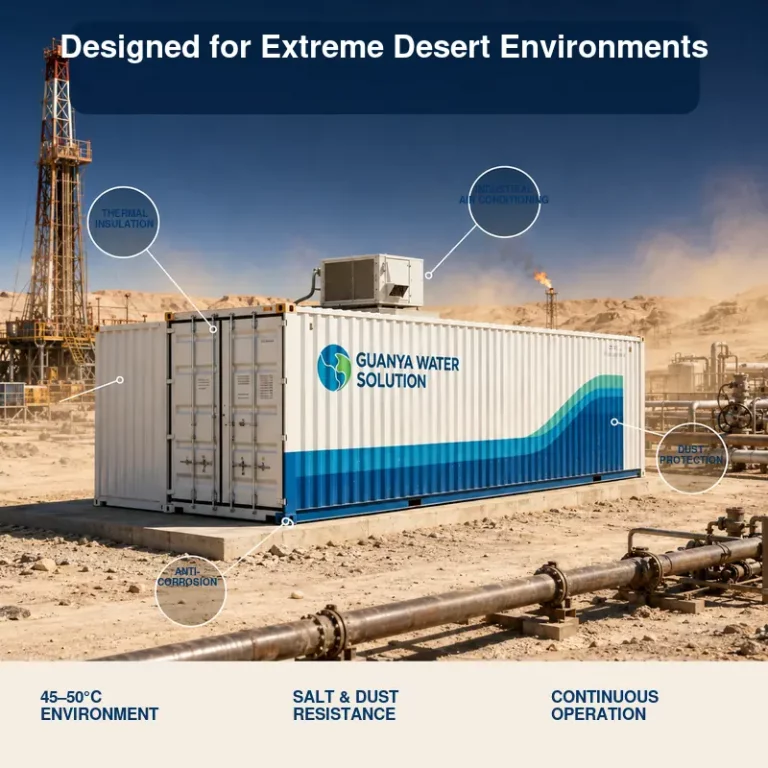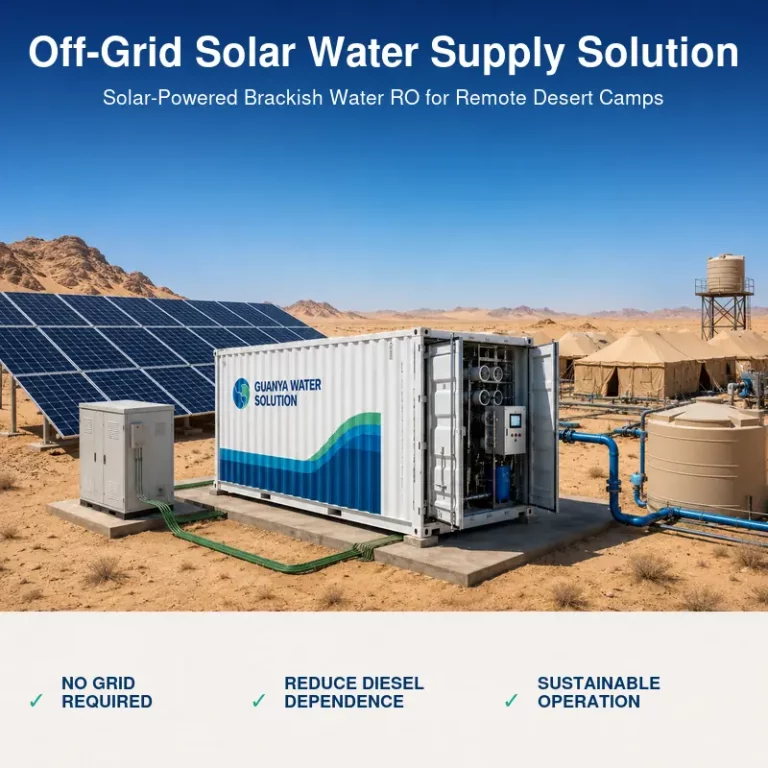
On an island, the treatment container is rarely the slowest part of a desalination project. Intake quality, intake reliability, and a lawful place to send concentrate (brine) decide whether a factory-tested plant can actually run. This article explains how GUANYA WATER SOLUTION usually divides that work. It does not claim that GUANYA obtains environmental or discharge permits, and it does not prescribe a single intake style for every coastline.
Where the containerized plant starts and stops
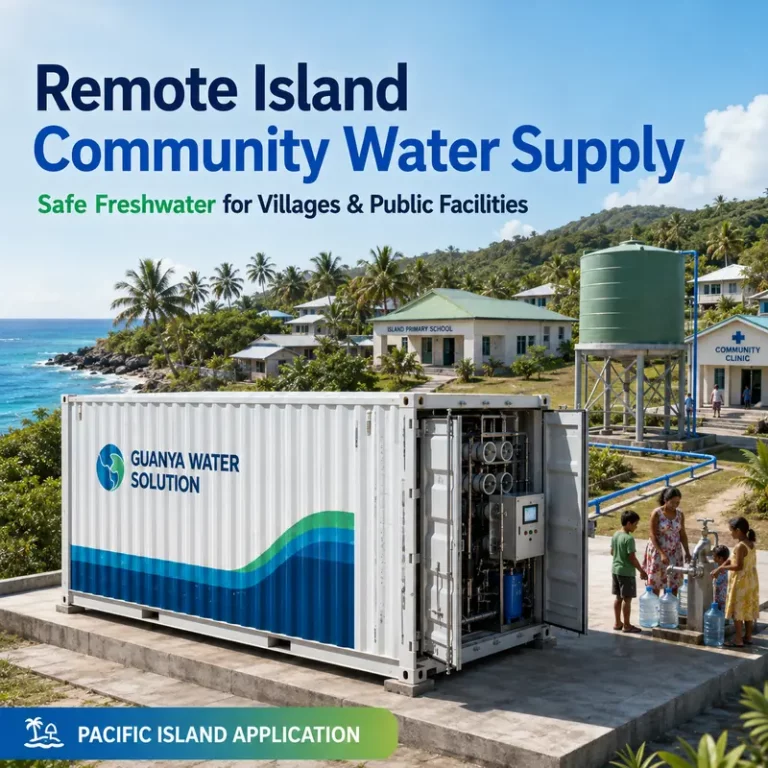
A factory-integrated SWRO module is connected to the site at a small number of interfaces, confirmed in the project utility list and hook-up drawings:
- Feed inlet — flange or union, sized for the design flow. Raw-water storage and any booster arrangement follow the agreed scope.
- Product outlet — to the owner’s storage tank.
- Concentrate / drain — piped to the owner’s approved discharge or drain point.
- CIP connection — typically included on the module; chemicals are usually by the owner.
- Power — voltage and frequency as confirmed in the project documents.
GUANYA’s engineering work defines those connections, the required feed quality, the expected concentrate flow at the design recovery, and the start-up sequence. The plant is FAT-tested before shipment so that, once the interfaces are made, start-up follows a sequence already demonstrated in the factory.
What the owner or civil contractor typically provides
Unless a contract expressly includes marine or civil works, the following remain on the owner’s side:
- the seawater intake itself — for example a shore intake, existing seawater pumps, a beach well or infiltration arrangement, or another site-specific design already used on the island
- raw-water screening or coarse filtration ahead of the GUANYA feed connection, if it is not inside the supplied module
- raw-water and product-water tanks, or the reuse of existing tanks after their condition, nozzles and elevations have been checked
- routing, supports and materials for external pipework
- a permitted concentrate discharge, including any mixing, outfall or monitoring the permit requires
- lifting, foundation or level pads, and any local enclosure against weather or noise
Intake style is not chosen from a catalogue at quotation stage. It is confirmed against a current seawater analysis, seasonal algae or silt observations, existing pumps and tanks, and the island’s environmental rules. A reducing, low-oxygen well intake, an open shoreline intake, and a harbour intake do not present the same pretreatment problem.
Feed quality and pretreatment
The owner is asked for a recent raw-seawater report (as a minimum: TDS or conductivity, pH, temperature, turbidity, and, where relevant, iron, manganese, oil and grease, organic indicators, and visible algae or slime). Operating hours, current pressures, and seasonal changes help set pretreatment and the chemical programme.
Poor intake design shows up later as cartridge consumption, frequent CIP, or unstable product quality. Those issues are not solved by promising a short hook-up time. They are solved by agreeing the intake and the pretreatment before manufacture, and by running the plant inside its documented limits after start-up.
Concentrate (brine) discharge
Concentrate leaves the module at the flow and salinity implied by the design recovery. Where it may be discharged, how it is mixed, and what monitoring is required are site-permit questions. GUANYA provides the connection and the design concentrate flow; the owner is responsible for a lawful discharge path. This article does not state a universal discharge pressure, dilution ratio, or environmental approval service.
If the site cannot accept concentrate, that constraint has to be known before the recovery and the hydraulic design are frozen.
Start-up still depends on these interfaces
Factory assembly and FAT shorten work inside the container. They do not replace intake readiness, a filled raw-water tank, a live power supply, or an approved drain. First water therefore cannot be promised as a fixed number of hours after the container arrives. The conservative, accurate statement is the one used on GUANYA’s current island product pages: the plant is pre-assembled and pre-tested; after the intake, power and product connections are made, start-up follows the documented sequence, and the calendar depends on site conditions.
Companion articles: factory acceptance and commissioning; spare parts; remote support; chemical dosing and CIP.