Mine drainage and process wastewater are not automatically a reverse-osmosis problem. The right plant depends on whether the owner must meet a discharge limit, a reuse specification, or both. This article explains how GUANYA WATER SOLUTION usually separates those duties. It is a technical article, supported by a design-stage example in Peru. It is not an operating-plant reference.
A design-stage example in Peru
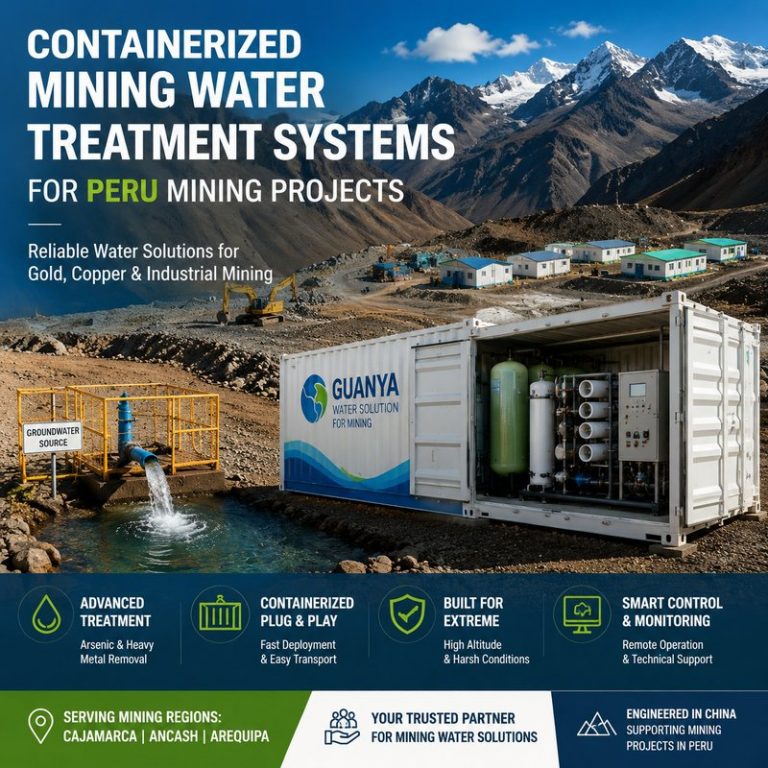
GUANYA has prepared a compact, containerized / skid neutralization design for acidic mine drainage at a polymetallic mine in Peru, in the Andes region of South America. The reference capacity is 2.5 m³/h peak, with an operating range of 1.2–2.5 m³/h. The work is at design and quotation stage. The unit has not been manufactured or commissioned by GUANYA, and the figures below are from the client-provided design basis already published on that page, not from an operating plant.
The full design note is here: Acid mine drainage treatment for a polymetallic mine in the Andes region of South America.
| Item | Design-basis value (not an operating result) |
|---|---|
| Country / setting | Peru, Andes region, polymetallic mine (identity withheld) |
| Flow | 2.5 m³/h peak (operating range 1.2–2.5 m³/h) |
| Raw water | pH 2.40; total acidity 4,700 mg/L as CaCO₃; total iron 180 mg/L; zinc, copper, lead and arsenic present |
| Stated duty | Treatment designed against client-specified national mining-effluent limits (discharge), not a reuse plant |
| Proposed process | Two-stage neutralization, flocculation, lamella settling, and closed-loop sludge dewatering |
| Status | Design proposal and quotation issued — not manufactured or commissioned |
When neutralization is enough
Where the legal duty is a discharge standard that limits pH, metals and suspended solids, but does not limit TDS, a neutralization–precipitation–solids-separation train can be the correct first plant. In the Peru design, TDS was 5,250 mg/L and was not regulated by the stated discharge standard, so a membrane desalination stage was not included. That choice remains subject to a current water analysis and confirmed guarantees. It is not a rule for every mine.
When reuse needs a second stage
If the mine later wants the clear water for process reuse or for a tighter specification, the correct tie-in is usually the clarified outlet of the metals-removal plant, followed by filtration and, where TDS, hardness or silica require it, nanofiltration or reverse osmosis. Adding membranes up front, before acidity and metals are controlled, typically raises fouling and sludge risk without solving the discharge parameters.
Reuse therefore starts with the same questions as camp or process water: what is the source, what is the use, and what may be discharged. A reuse plant is a new design, not an automatic add-on of a catalogue RO skid.
Sludge is part of the water-treatment design
Acidic drainage with a high metals load produces sludge. The Peru design returns filter-press filtrate to the head of the plant and assigns dewatered cake to an authorized disposal route, subject to waste characterization. The cake rate on that page (about 2.1 t/day wet at design flow) is a design-stage estimate, not an operating result. A proposal that is silent on sludge is not a complete mine-drainage design.
Related reading
- Andes AMD neutralization design, 2.5 m³/h, Peru — design and quotation only
- Mine camp water supply
- Mine wastewater reuse — product platform
Frequently Asked Questions
Is the Peru AMD unit a built or operating plant?
No. It is a design proposal and quotation for a 2.5 m³/h peak integrated neutralization unit. It has not been manufactured or commissioned by GUANYA, and it is not an operating-plant reference.
Does every mine-drainage plant include reverse osmosis?
No. Membranes are added when the discharge or reuse target requires a reduction in TDS or in other dissolved parameters that neutralization and solids separation do not remove. The process is chosen from the current analysis and the owner’s target.
Can this 2.5 m³/h design be used at a higher flow?
A different flow needs a new design based on a current water analysis, the discharge or reuse target, and site constraints. No scale-up capacity is stated as a guaranteed figure.