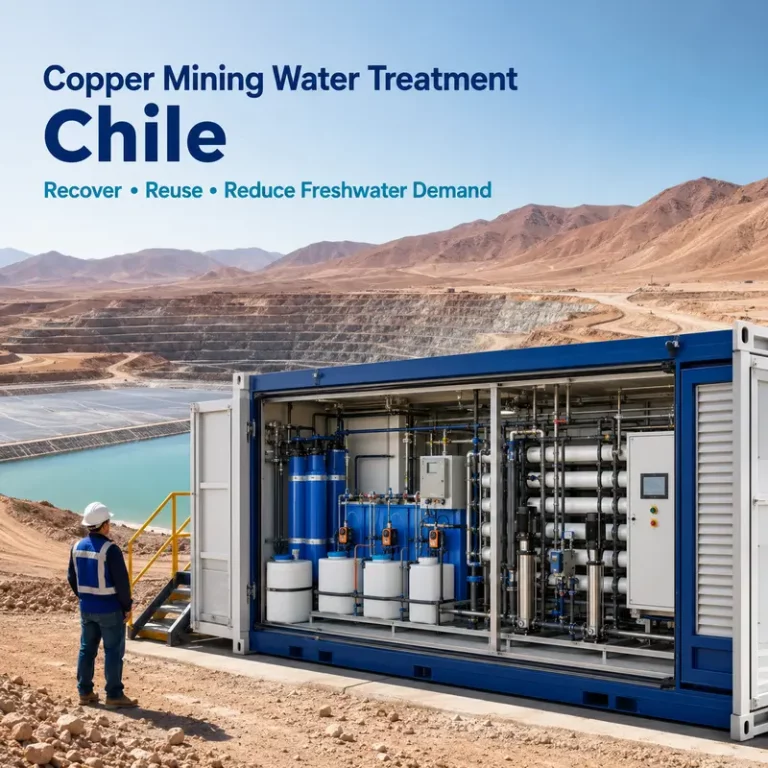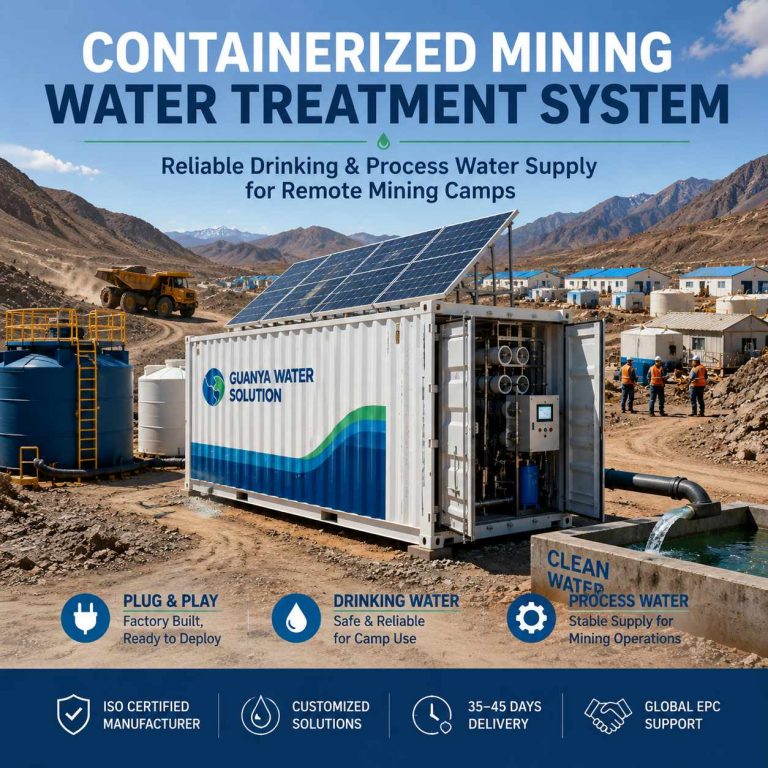
GUANYA WATER SOLUTION has prepared a drinking-water treatment design for a worksite in Chile that has no municipal water connection and is supplied from an on-site deep well. The design treatment flow is 2.0 m³/h. The drinking-water target is the Chilean standard NCh 409/1. The work is at design and quotation stage (documents dated November 2026). The unit has not been manufactured or commissioned by GUANYA, and this note is not an operating-plant reference.
This is a different treatment duty from GUANYA’s published mining brackish-water RO inquiry work in Chile. It is a well-water arsenic-removal and disinfection train, not a reverse-osmosis plant. Client identity and the worksite name are withheld.
Status: Design proposal and quotation issued | Country: Chile | Water source: Deep well | Intended use: Worksite drinking water to NCh 409/1 | Design flow: 2.0 m³/h
Design basis (proposal stage, not measured operation)
The following figures are taken from the design documents. They are not field measurements from a running plant.
| Item | Design-basis value |
|---|---|
| Country | Chile (worksite identity withheld) |
| Design treatment flow | 2.0 m³/h, matched to the well pump while it is running |
| Planning daily use | 6 m³/day |
| Peak site demand | Estimated 90–120 L/min, carried by a contact storage tank and a variable-speed booster, not by the treatment train |
| Standard | NCh 409/1, Drinking water — Part 1: Requirements |
| Feed arsenic (third-party analysis used in the design) | 0.0185 mg/L, against the NCh 409/1 limit of 0.01 mg/L |
| Internal design target for product arsenic | 0.005 mg/L, to leave a margin for breakthrough warning (50% of the limit) |
| Other feed issues in the same analysis | Total coliforms detected; free chlorine below 0.02 mg/L (the standard range is 0.2–2.0 mg/L); TDS 1,050 mg/L; nitrite 1.96 mg/L, which increases chlorine demand |
| Status | Design and quotation — not shipped, not commissioned |
Because TDS is only moderately elevated and the parameters that fail the drinking-water standard are arsenic, microbiology and residual chlorine, the design does not use reverse osmosis. A “chlorination only” or “filtration only” train was also rejected: nitrite consumes disinfectant, and arsenic at 0.0185 mg/L requires a dedicated removal stage.
Proposed process
Pretreatment oxidation (sodium hypochlorite, to oxidize arsenite to arsenate) → pH adjustment (the revised package includes a 1 t pH-adjustment tank) → two-stage lead-lag adsorption on granular ferric hydroxide media (SY02-P) → cartridge filtration → ultraviolet disinfection → residual-chlorine dosing for the worksite network.
Key adsorption-design figures, all proposal-stage:
- About 125 L (about 150 kg) of media in each vessel; two stages total about 300 kg
- Empty-bed contact time 3.75 minutes per vessel and 7.5 minutes in series, at 2.0 m³/h
- Design pressure range 2–6 bar, in standard 16-inch-class FRP vessels
- Media life used only for planning (a conservative 30,000 bed volumes, about two years at 1,800–2,200 m³/year). Replacement is decided by the arsenic result at the sample point between the two vessels, not by the planning life
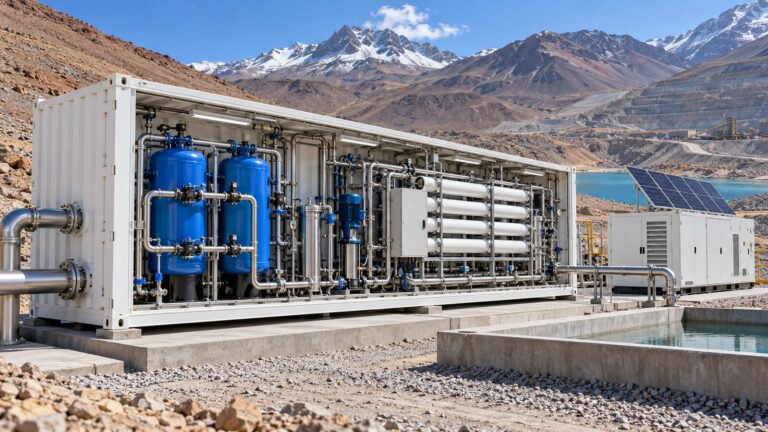
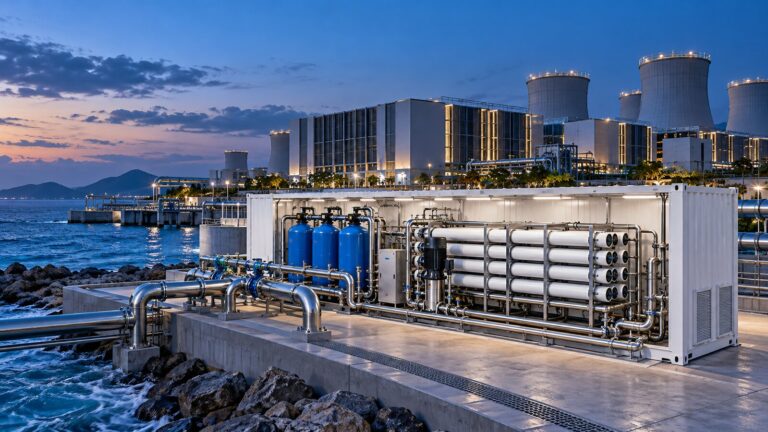
The revised November package places the treatment equipment in a 20 ft container, with an access aisle inside the box. The contact storage tank and the booster set remain outside the container.
What this page is not
It is not a shipped or operating case. It is not a copper-mine brackish-water RO reference, and it should not be used to upgrade any existing Chile mining-RO page on this site. Performance, media life in the field, and time to first water are not published as measured results. Time to first water, if the design proceeds to manufacture, would still depend on well, power, tank and hook-up conditions.
Related reading
- How to remove arsenic from water (general technical / solution page)
- Mine camp water supply: containerized treatment
- Mine drainage treatment and water reuse
Frequently Asked Questions
Has this Chile well-water system been shipped?
No. The status is design and quotation (November 2026). The unit has not been manufactured or commissioned by GUANYA, and this page is not an operating-plant reference.
Why is reverse osmosis not used in this design?
The documented failures against NCh 409/1 are arsenic, microbiological quality and residual chlorine. TDS in the design analysis is 1,050 mg/L. The selected train is oxidation, pH adjustment, two-stage arsenic adsorption, cartridge filtration, UV and residual chlorine. A different analysis could lead to a different process.
Is the 2.0 m³/h figure a measured operating result?
No. 2.0 m³/h is the design treatment flow, matched to the well pump. The planning daily use is 6 m³/day. Peak demand is intended to be absorbed by storage and a booster, not by the treatment train.