GUANYA WATER SOLUTION has prepared a containerized design for domestic wastewater from a hotel in the Dominican Republic. The design treatment capacity is 900 m³/day. The proposed process is anoxic–oxic (A/O) biological contact oxidation with moving-bed biofilm (MBBR) media, followed by a membrane bioreactor (MBR) for solid–liquid separation. The hotel name is withheld.
Country: Dominican Republic | Duty: Hotel domestic wastewater | Design capacity: 900 m³/day
The problem
A hotel site in the Dominican Republic needed a compact plant to treat domestic wastewater at 900 m³/day, with a biological process that could be delivered in containerized modules rather than a large civil works plant. The design document does not state a room count for the hotel; that figure is not used on this page.
How the scheme solves it
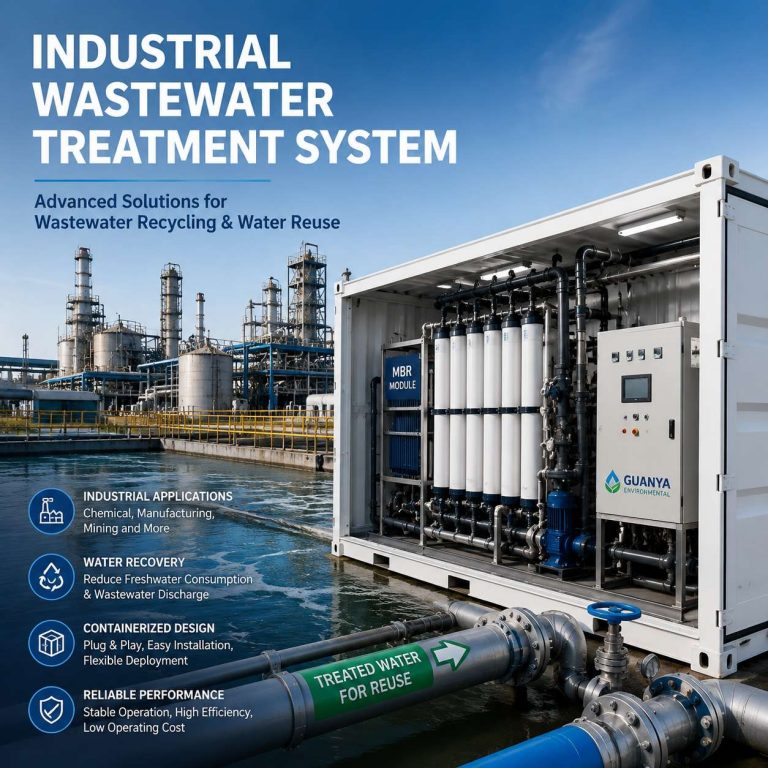
GUANYA prepared a containerized A/O + MBBR + MBR treatment scheme for hotel domestic wastewater, arranged in six 40 ft high-cube modules (two groups of three containers in series). In the anoxic section, denitrifying bacteria use organic matter in the wastewater as a carbon source and convert nitrate from the aerobic recycle stream into nitrogen gas. In the aerobic section, MBBR media provide attached biomass and aeration supplies dissolved oxygen. The MBR membrane section provides final solid-liquid separation with hollow-fiber curtain modules, so that mixed-liquor concentration can be kept high and effluent clarity improved.
Internal process sections include the anoxic tank, aerobic tank, MBR membrane tank and a clean-water tank. The containers are 40HQ, about 12.192 m long, and the design notes a total footprint of about 238 m² and a design operating power of about 36 kW. Units are factory-assembled and factory-tested; time to first treated effluent depends on site sewer, power, tanks and hook-up.
Design basis
| Item | Design-basis value |
|---|---|
| Country / setting | Dominican Republic, hotel site (identity withheld) |
| Design capacity | 900 m³/day of domestic wastewater |
| Proposed process | Screening and sewage inlet → anoxic tank → aerobic contact-oxidation tank with MBBR media → MBR membrane tank → clean-water tank |
| Intended removal | Organic matter, nitrogen, phosphorus reduction and effluent polishing by membrane separation, subject to a confirmed influent analysis and commissioning |
| Integration | Containerized modules: two groups of three 40HQ containers in series, six 40HQ containers in total, in the proposal. Site civil works, influent collection and external piping remain on the owner’s side unless a later contract says otherwise. |
| MBR (design) | Hollow-fiber curtain membranes in PVDF, with sludge return in the design |
The proposal states that final treatment performance depends on confirmed influent quality, operating load and biological acclimation. No effluent numbers are published here as measured results or as universal guarantees.
Related reading
- Mine drainage treatment and water reuse (different duty; design-stage mining example)
- Brazil coastal SWRO, 18 m³/h
Frequently Asked Questions
How is the 900 m³/day figure derived?
It is the design treatment capacity in the proposal. Actual throughput depends on confirmed influent quality, load and commissioning.
Why MBBR and MBR together?
The proposal uses MBBR media in the biological tanks for a compact footprint, and an MBR membrane stage for final solid–liquid separation and effluent polishing. The process is selected for this hotel-wastewater duty; it is not a universal template for every sewage plant.