GUANYA WATER SOLUTION logo

GUANYA WATER SOLUTION

Modular Containerized Seawater Desalination Plants | 50–1,000 m³/day

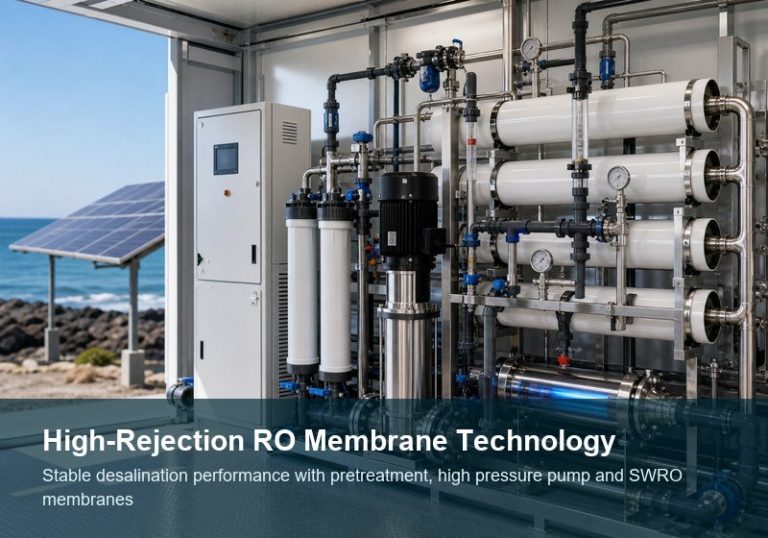
GUANYA designs and builds modular containerized seawater desalination plants from 50 to 1,000 m³/day — engineered for islands, coastal resorts and maritime projects that need utility-grade water without utility-grade construction. Every plant is 100% assembled and FAT-tested inside our ISO-certified factory with globally serviceable components: DuPont/Hydranautics membranes, KSB/Danfoss high-pressure pumps and Siemens/Schneider automation. Pressure-exchanger energy recovery cuts consumption to as low as 2.8–3.2 kWh/m³, and parallel-container modularity lets you add capacity like building blocks as demand grows. Typical production lead time: 35–45 days from engineering confirmation to shipment.

For off-grid solar-powered plants, see the solar-powered desalination plant for remote islands. Relocatable mobile / skid-mounted units are covered on the mobile product page. Hospitality projects can review the island resort desalination system. Send your water analysis and required daily output for selection.

Product Details

Product Details

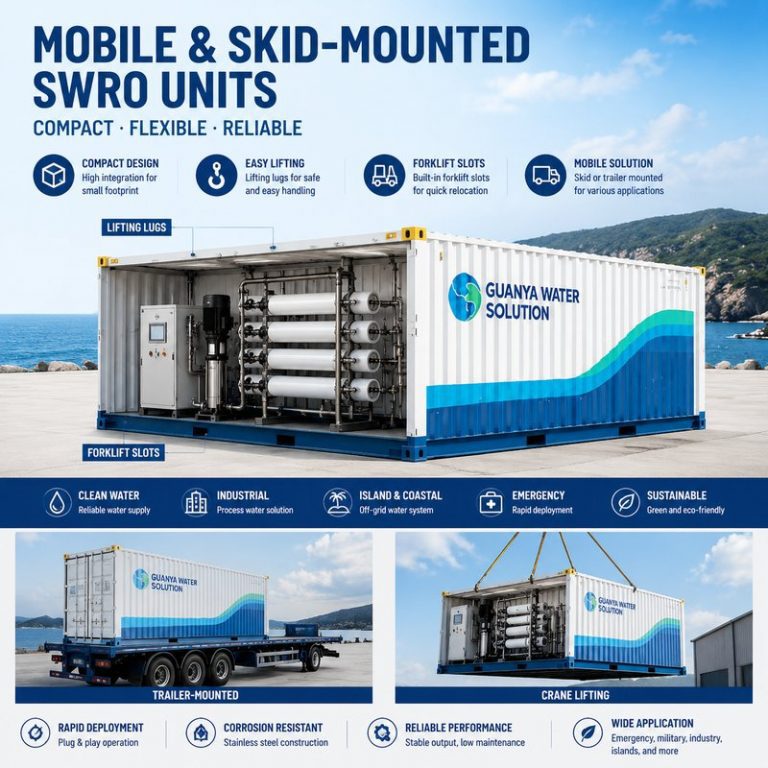
Mobile & Skid-Mounted SWRO Units

GUANYA also builds compact, relocatable plants for temporary or rapidly changing sites. For models, mounting options and the GY-SW series range, see our mobile skid-mounted SWRO units.

Unpack and connect the intake and power. Start-up still depends on intake, power, commissioning and storage. Return here for utility-scale modular container trains when demand is static and growing.

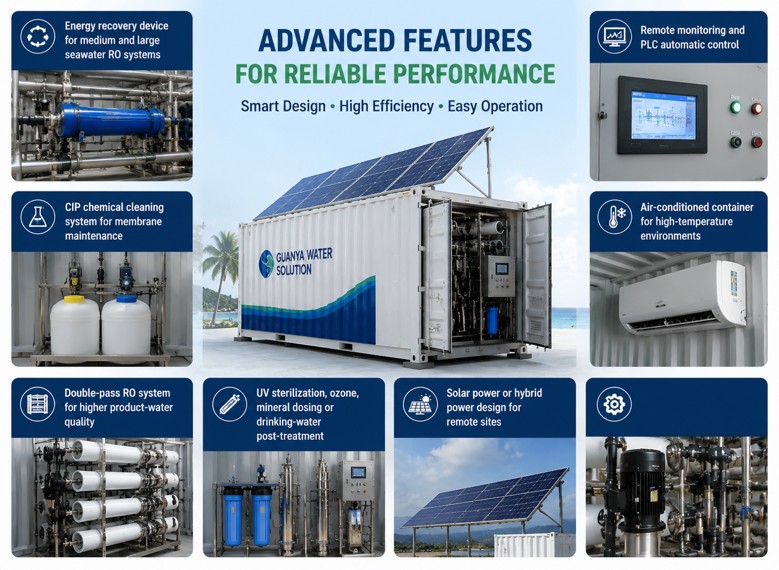
Feature collage of a solar containerized seawater RO system

Top 5 Advantages of Containerized Systems


1. True Plug-and-Play Integration

Our systems feature 100% full-system integration inside our ISO-certified factory—including pre-treatment, RO vessels, pumps, dosing loops, and pipelines. Once delivered, connect the water lines and power. How soon the plant can produce water still depends on intake, power, commissioning and storage being ready.

2. Minimal Civil Infrastructure

A containerized system serves as its own rugged, weather-proof equipment room. It requires near-zero civil engineering—only a flat concrete pad or leveled ground. This drastically cuts upfront civil CAPEX and bypasses strict environmental and building permit restrictions in eco-sensitive coastal zones.

3. Marine-Grade Ruggedization

High salt-spray and humidity quickly corrode standard equipment. GUANYA uses heavy-duty Corten steel sea freight containers coated with multi-layer marine epoxy. Outfitted with industrial climate control (HVAC) and heavy insulation, this protective shell shields high-value components, significantly extending asset lifespan.

4. Highly Scalable & Easily Relocatable

The modular design allows you to scale fresh water production incrementally—like building blocks—by adding parallel containers as your project grows. Furthermore, the entire plant can be easily hoisted via crane and relocated to a new camp, ensuring 100% capital asset recovery.

5. Risk-Free Factory FAT Verification

Commissioning systems in remote areas carries high risks. GUANYA conducts exhaustive Factory Acceptance Testing (FAT) under full hydraulic load and simulated field water conditions before shipment. We verify all PLC automation, pressure thresholds, and safety interlocks to ensure a zero-defect plant arrives at your site.

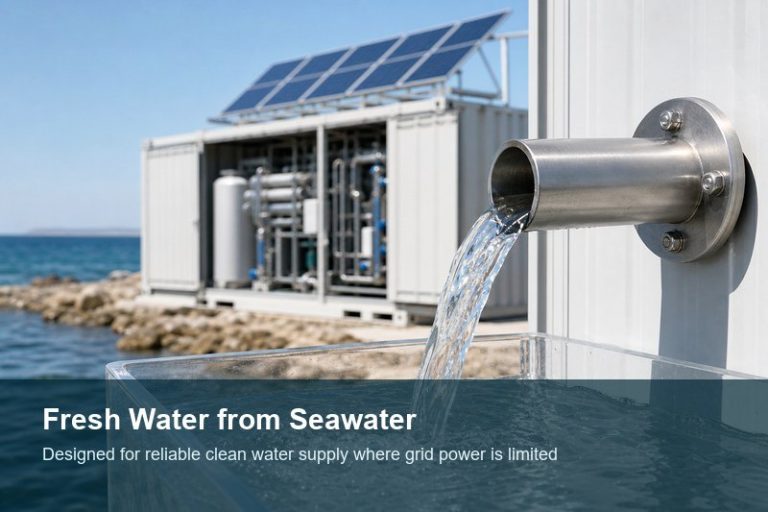
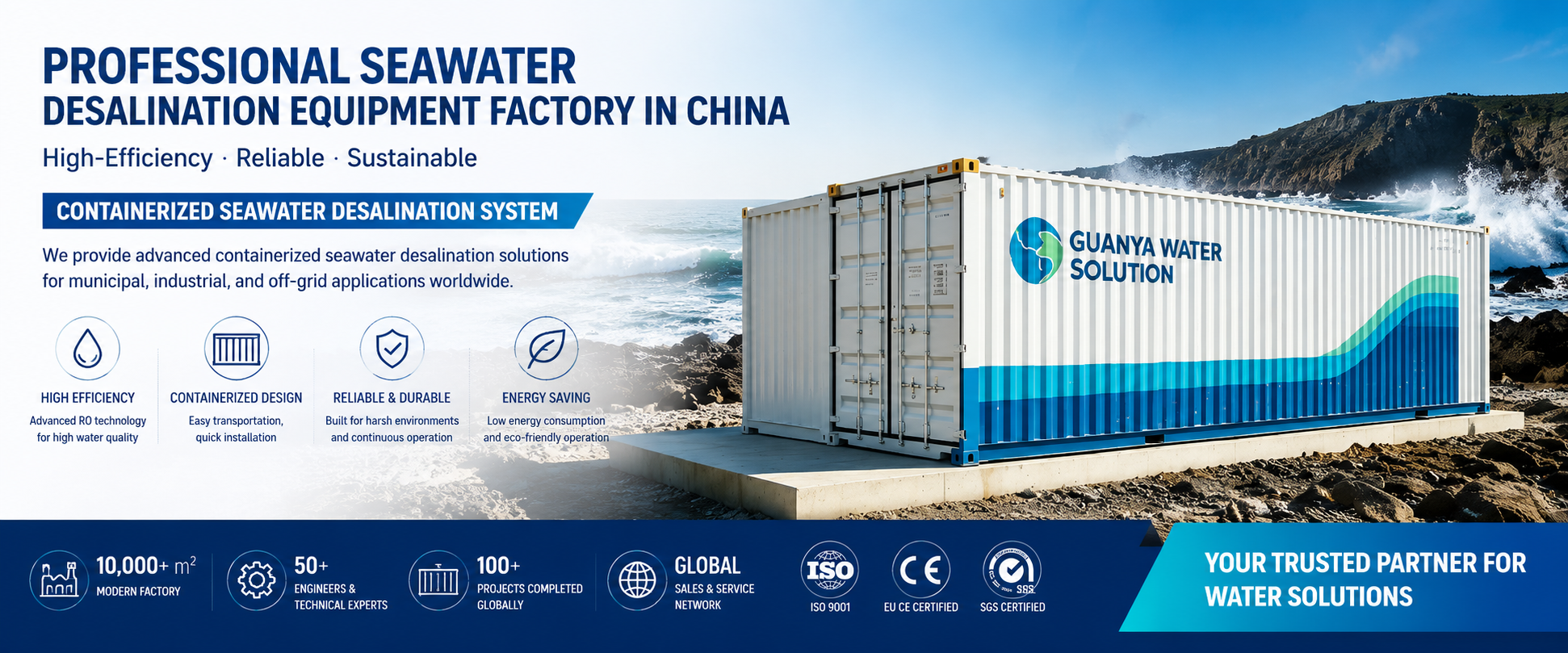
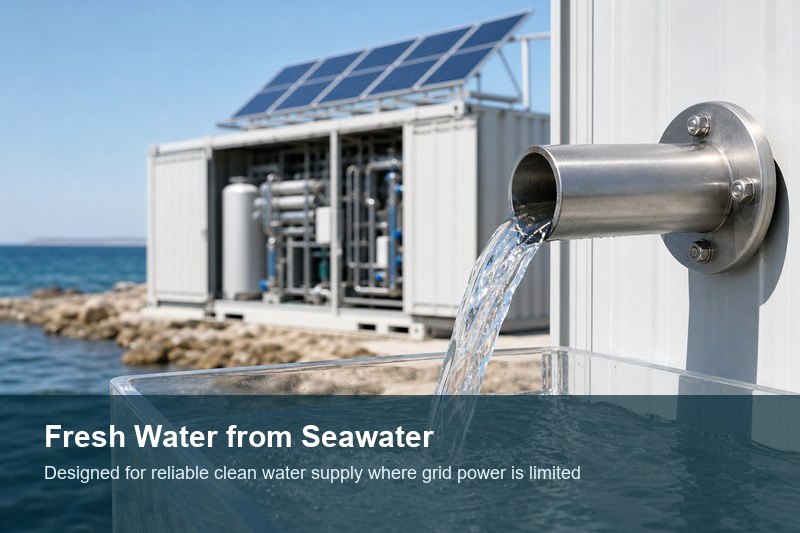
Containerized seawater desalination system on a rocky coast

If you are considering an RO unit, contact us for an economical water treatment solution today

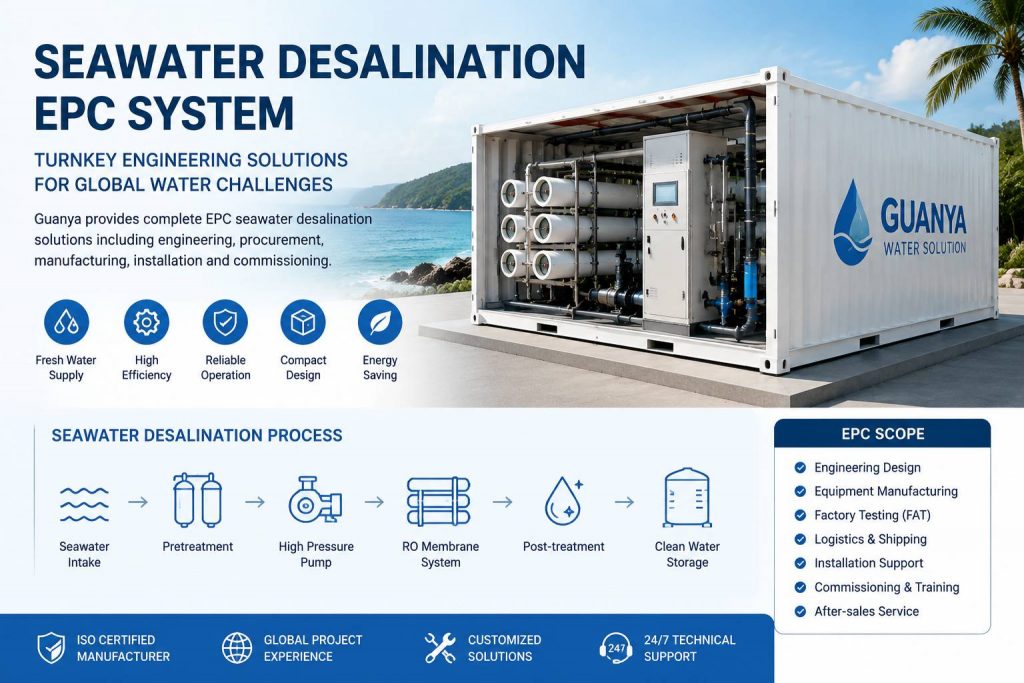
Containerized seawater desalination system and process diagram

Standard Containerized SWRO Plants

For coastal communities, resorts and small-scale industrial sites, our standard containerized seawater reverse osmosis (SWRO) systems eliminate the need for concrete plant buildings. Housed in reinforced, marine-grade insulated 20ft or 40ft containers, they arrive fully integrated with pretreatment, RO membranes and post-treatment, and they scale by adding parallel trains.

Configuration Capacity Containers Typical Site
Single 20ft 50–100 m³/day 1 Boutique resort, work camp
Single 40ft HC 100–240 m³/day 1 Mid-size resort, coastal village
Parallel 40ft × 2–4 240–960 m³/day 2–4 Island municipality, industrial site
Custom EPC up to 1,000+ m³/day project-based Utility-scale turnkey plant

Off-Grid Solar Desalination Solutions

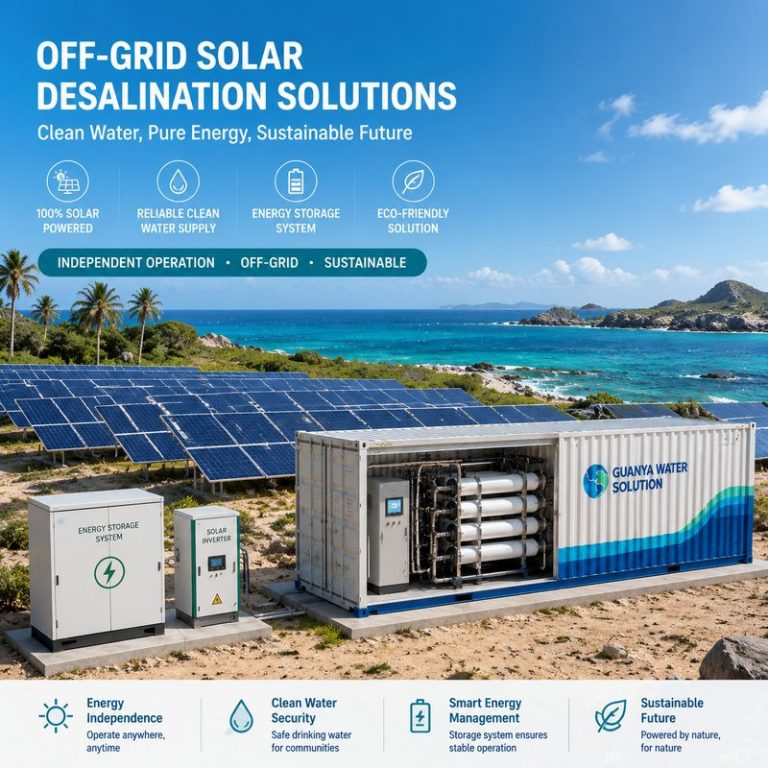
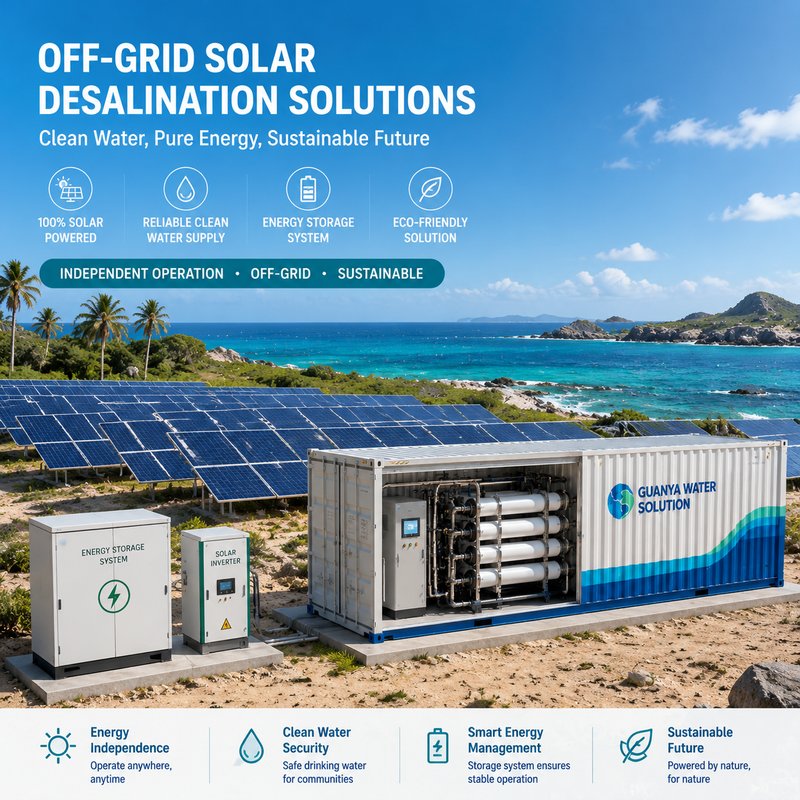
Remote islands and eco-resorts can specify hybrid PV, battery, grid or generator power on a modular containerized plant. For a dedicated solar-powered desalination plant for remote islands, see that product page — this page stays focused on modular, scalable containerized trains.

Off-grid solar desalination system
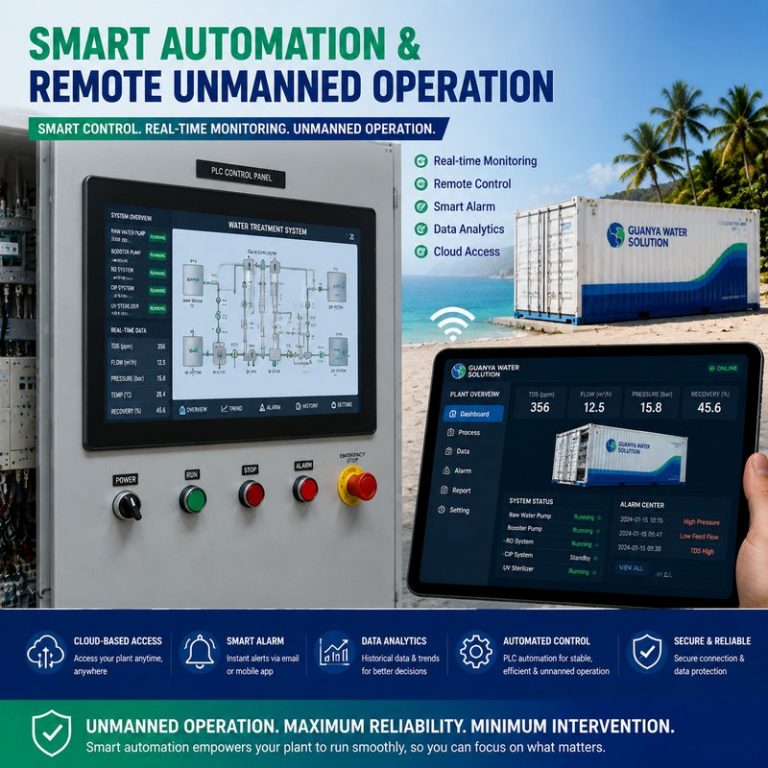
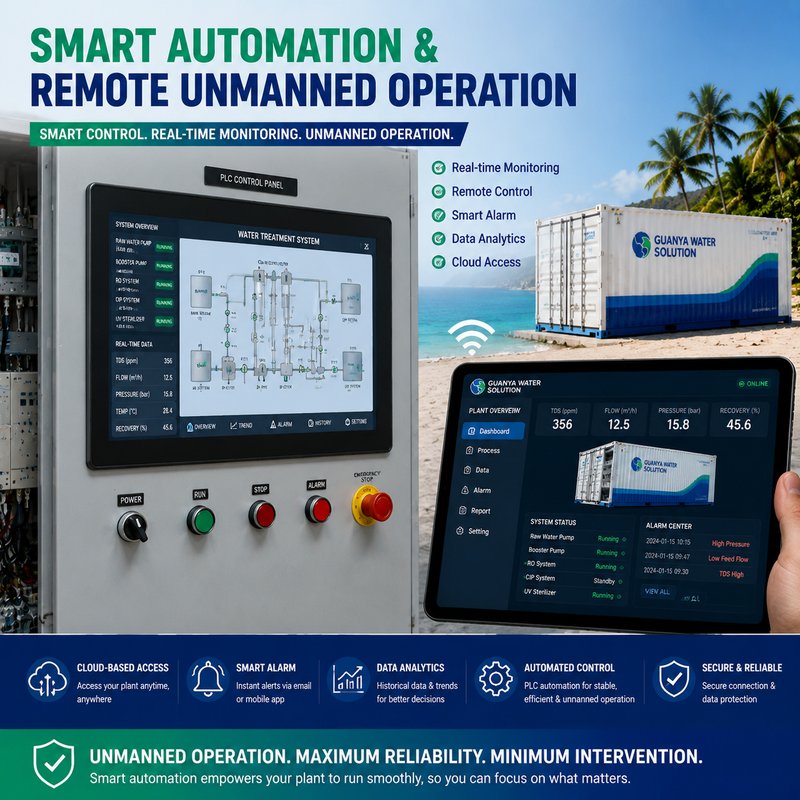
Control interface for automated desalination operation

Advanced Energy Recovery Technology

  •  High-Efficiency Energy Recovery for Low Operational Opex

  •  Desalination is traditionally energy-intensive. To make small and medium-scale operations financially viable, our systems are equipped with state-of-the-art Isolator-type or Pressure Exchanger Energy Recovery Devices (ERD). By capturing and recycling hydraulic energy from the concentrated brine waste stream back into the feed loop, we reduce total system energy consumption by up to 35% to 40%, driving down power requirements to as low as 2.8–3.2  kWh/m

Smart Automation & Remote Unmanned Operation

  • Cloud-Based Smart PLC for Unmanned Remote Operations

  •  Most islands and remote coastal locations lack experienced water treatment engineers. Our systems are built around a central Smart PLC architecture (Siemens/Allen-Bradley) with automated membrane flushing, chemical dosing loops, and online water quality (TDS/pH/Turbidity) monitoring. With integrated satellite/cellular IoT gateways, your operations team can monitor system health, track performance metrics, and receive predictive maintenance alerts remotely from any office worldwide.

Fresh water produced by a solar desalination system
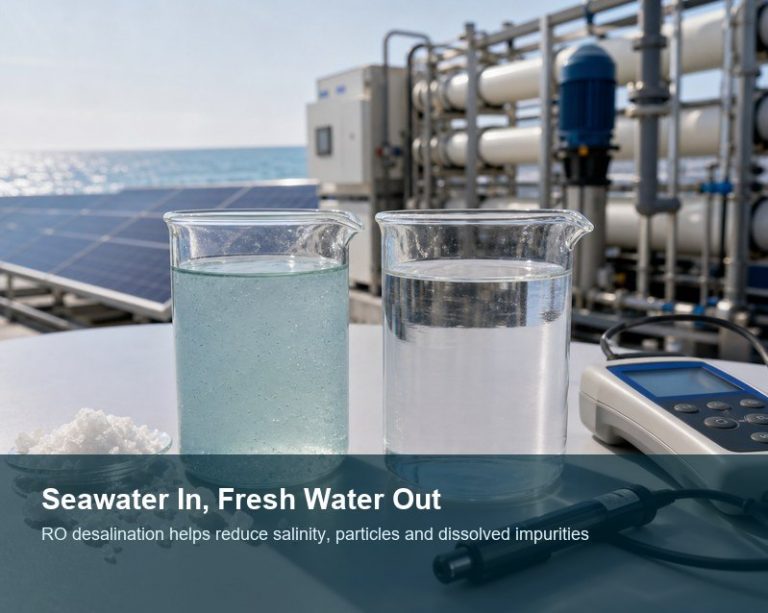
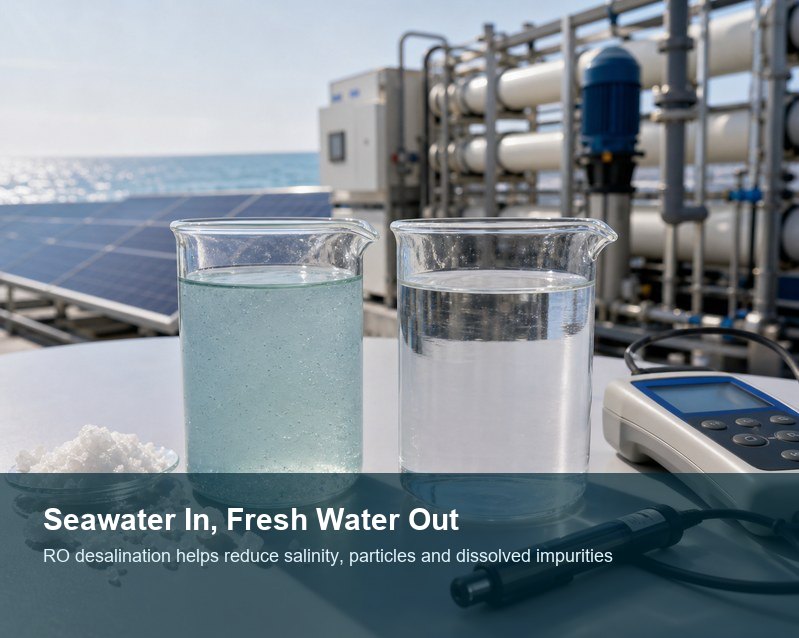
Seawater and product-water quality comparison display

FAQ Section

  • Q1: What infrastructure do I need to prepare on-site for a containerized SWRO system?

    • A: Minimal infrastructure is required. You only need a flat, reinforced concrete pad or leveled ground to support the weight of the container, a sea-water intake source (beach well or open-sea intake pump), brine discharge access, and a power connection (or our solar array field setup).

  • Q2: Can the solar desalination system work at night or during cloudy days?

    • A: Yes, we offer Hybrid Solar Systems. During the day, the system maximizes solar energy. For night or low-light operations, it can automatically and seamlessly switch to an auxiliary diesel generator, local grid power, or an integrated battery storage system based on your custom EPC design.

  • Q3: How do you handle the high salinity and varying water temperatures of different seas?

    • A: Our process engineers customize each system based on your specific water analysis. Whether it is the Mediterranean, the high-salinity Red Sea, or variable-temperature Pacific waters, we adjust membrane selection, flux rates, and high-pressure pump sizing to ensure steady, rated freshwater output.

Modular Capacity and Energy Questions

How does a modular plant scale if our water demand grows?

Capacity is added by connecting parallel containerized trains — no redesign of the existing plant. A resort can start with one 40ft unit at 240 m³/day and double capacity later by adding a second train.

What is the typical energy consumption and operating cost?

With pressure-exchanger energy recovery, specific consumption drops to 2.8–3.2 kWh/m³ — up to 40% lower than non-ERD systems. Your final OPEX depends on local electricity or diesel cost; send us your tariff and we will return a per-m³ cost estimate with the proposal.

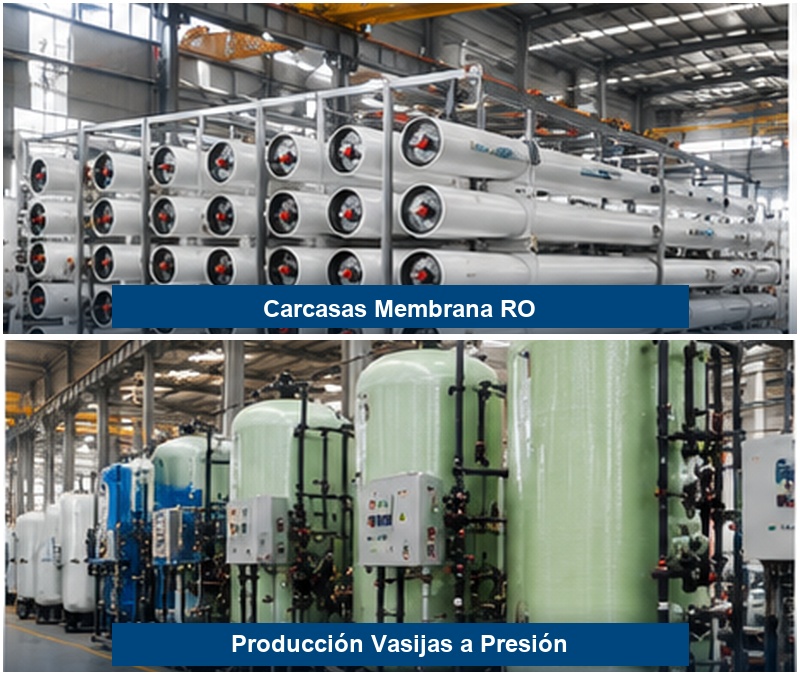
RO membrane housings and pressure vessels in the factory workshop
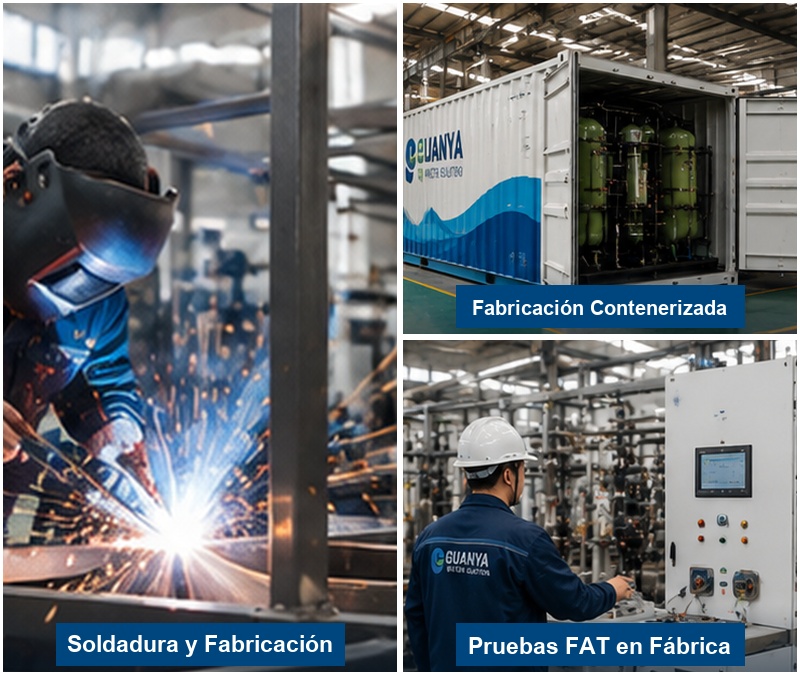
Welding, containerized system fabrication and factory acceptance testing
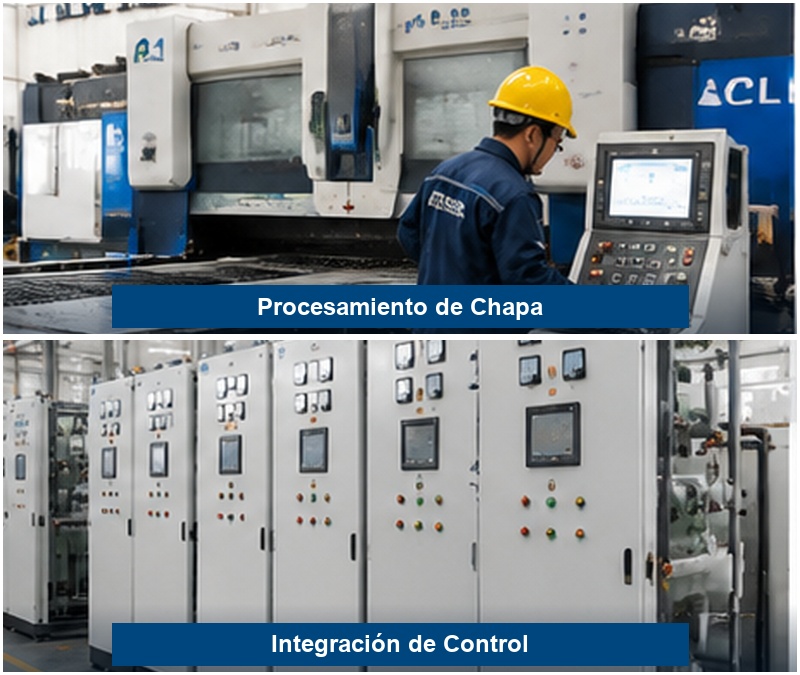
Sheet metal fabrication and control cabinet integration in the factory workshop
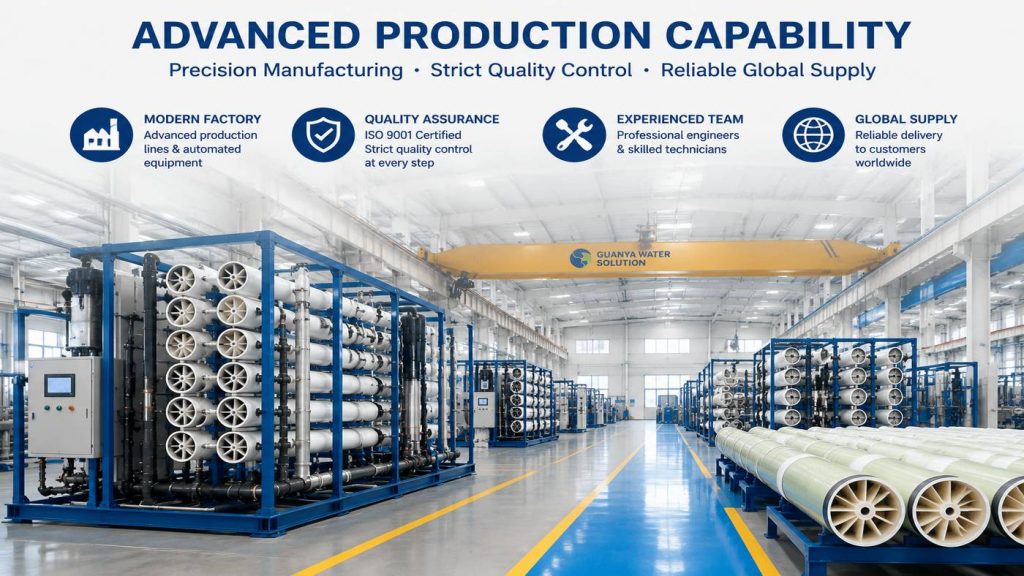
Factory workshop with RO membrane skids and membrane elements

Contact Us Anytime

Contact Us Anytime

Send Us a message

Product Catalog

180 m³/h SWRO Layout Options

Applications: Engineering comparison of containerized seawater desalination layouts for project planning.

Main parameters: Reference layouts: 180 m³/h; 6 × 30 m³/h without ERD or 12 × 15 m³/h with ERD and integrated CIP. Final design is project-specific.

Preview PDFDownload PDF

90 m³/h SWRO Technical Overview

Applications: Seawater desalination for islands, coastal facilities and industrial water supply.

Main parameters: Reference configuration: 90 m³/h; 3 × 40 ft HQ containers; 2 × 15 m³/h RO modules per container. Project-specific design.

Preview PDFDownload PDF