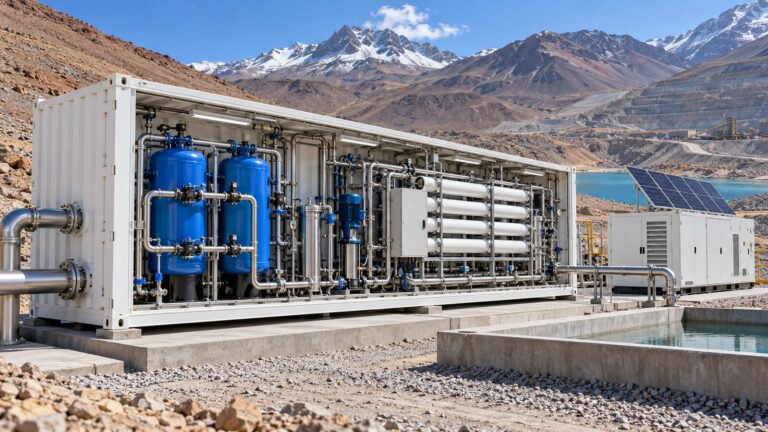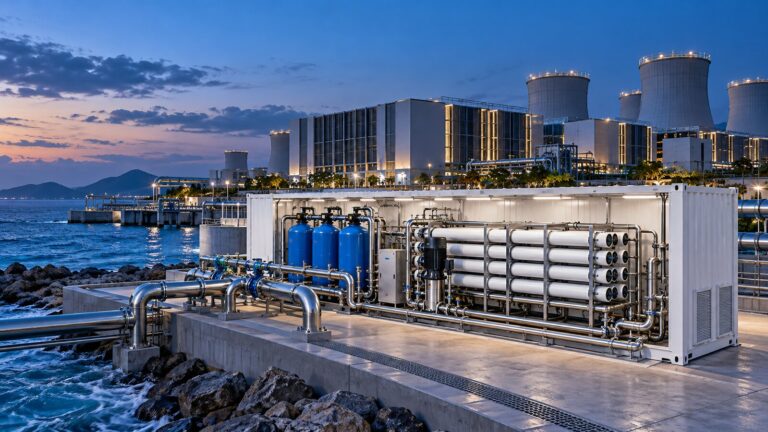
GUANYA WATER SOLUTION has prepared a containerized seawater reverse-osmosis (SWRO) design for a coastal site in Argentina. The design daily production is 1,500 m³/day, made up of five parallel 40 ft units, each rated 15 m³/h (75 m³/h combined). At 20 operating hours per day, that is the 1,500 m³/day planning figure. A 24-hour theoretical output of 1,800 m³/day is stated only as operating-time flexibility, not as a standby-unit guarantee. The site and client names are withheld.
This page is a different duty from GUANYA’s 12.5 m³/h / 250 m³/day Argentina SWRO design and from the 2.00 m³/h Argentina brackish-water design, which are published as separate notes.
Country: Argentina | Duty: Coastal seawater desalination | Design flow: 75 m³/h (1,500 m³/day at 20 h), five 40 ft units
The problem
A coastal site in Argentina needed a modular seawater RO plant with a design daily production of 1,500 m³/day. That figure is 1,500 m³/day, not 15,000 m³/day. The scheme is built from five parallel 40 ft units, each rated 15 m³/h (75 m³/h combined); at 20 operating hours that is the 1,500 m³/day planning figure. A 24-hour theoretical output of 1,800 m³/day is stated only as operating-time flexibility, not as a standby-unit guarantee.
How the scheme solves it
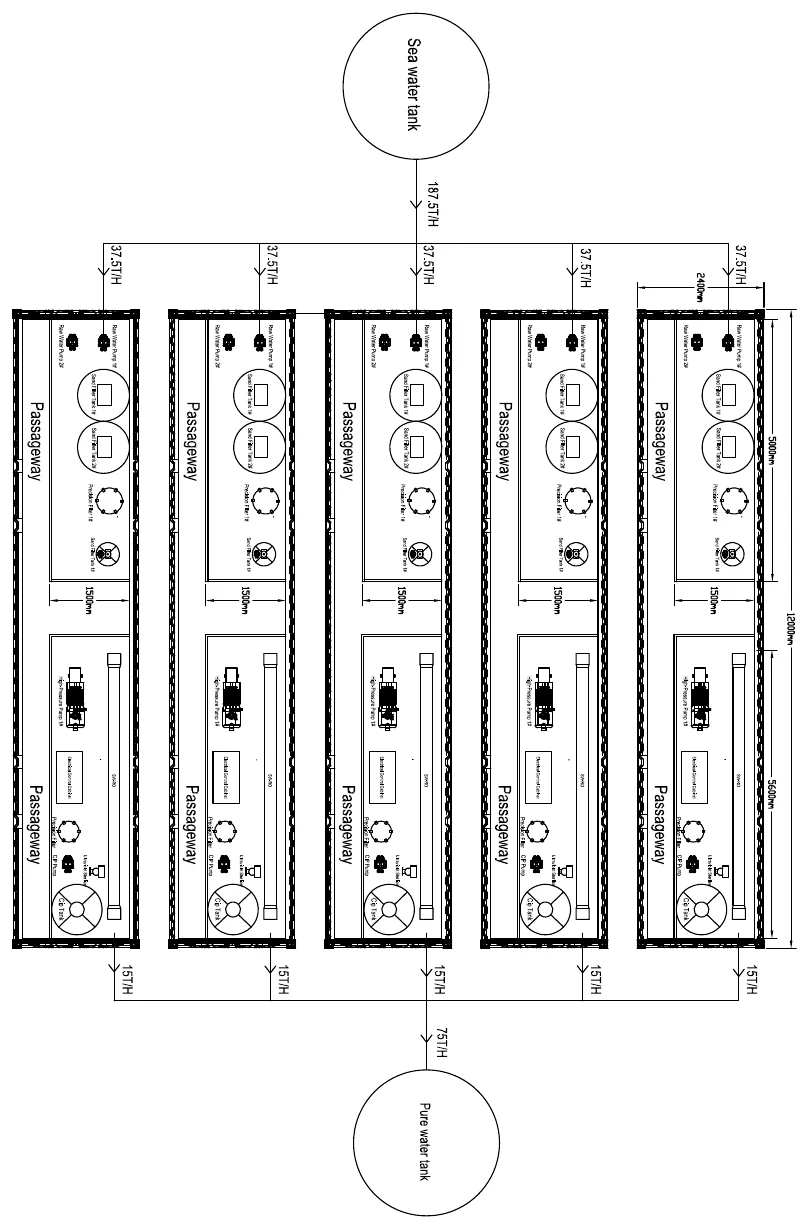
GUANYA prepared a five-unit containerized seawater RO treatment scheme, with a conventional option and an energy-recovery option. The general arrangement for the conventional option shows a seawater tank feeding five parallel 40 ft containers at 37.5 m³/h each (187.5 m³/h combined feed as marked on the drawing) and 15 m³/h of product from each unit (75 m³/h combined) to a product-water tank. Container dimensions marked on the drawing include a 12,000 mm length. The energy-recovery option is a separate design arrangement and is not required to use the page. Units are factory-assembled and factory-tested; time to first water depends on intake, power, storage and site hook-up.
Design drawings
Design basis
| Item | Design-basis value |
|---|---|
| Country / setting | Argentina, coastal site (identity withheld) |
| Design arrangement | Five independent RO units in parallel, each in a customized 40 ft container |
| Nominal permeate capacity | 15 m³/h per unit; 75 m³/h combined; 1,500 m³/day at 20 operating hours |
| Design feed | Seawater, TDS 36,632 mg/L, 25 °C, SDI < 5 |
| Design recovery | 41.0% (WAVE projection, 28 September 2026) |
| Projected permeate TDS | 156.9 mg/L (WAVE design prediction, not an acceptance guarantee) |
| Two design options | A conventional high-pressure option, and an option with an energy-recovery device. Both share the same nominal production. Permeate quality for the energy-recovery option is not assumed to be identical without a separate aligned projection. |
| Proposed process | Seawater feed pumping, sand filtration, cartridge filtration, antiscalant dosing, high-pressure RO, ultraviolet disinfection and connection to product storage. Concentrate is routed to an agreed discharge connection. |
WAVE figures are design predictions, not measured results. Factory assembly and factory testing are included in the description. Time to first water depends on intake, power, tanks and site hook-up.
Related reading
- Argentina coastal SWRO, 12.5 m³/h, 250 m³/day
- Argentina brackish-water RO, 2 m³/h
- Brazil coastal SWRO, 18 m³/h
Frequently Asked Questions
Is the capacity 15,000 m³/day?
No. The design daily production is 1,500 m³/day at 20 operating hours, from five 15 m³/h units.
Must the energy-recovery option be selected?
No. The proposal compares a conventional option and an energy-recovery option at the same nominal production. The option is selected in project engineering.