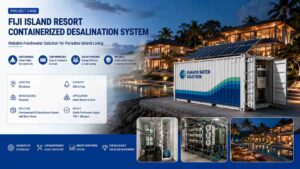
Three independent SWRO units with a combined rated capacity of 3 m³/h in one customized 20-foot container
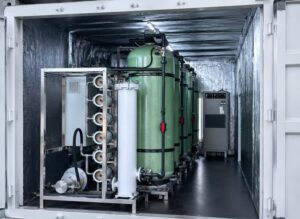
Guanya has shipped a containerized seawater desalination system for a luxury island resort in Fiji. The project combines three independent seawater reverse osmosis (SWRO) units, each rated at 1 m³/h, inside one customized 20-foot container equipped with insulation and industrial air conditioning.
The configuration brings factory-integrated water treatment equipment to a location where installation access, operating flexibility and maintenance planning matter. With independent units, the resort can match production to demand and continue operating the remaining units when one is taken out of service. This project overview covers the shipped configuration and the preparations needed for installation and commissioning.
Project specifications
| Parameter | Project configuration |
| Destination and application | Fiji island resort water supply |
| Project status | Shipped |
| Treatment technology | Seawater reverse osmosis |
| Unit configuration | Three independent units at 1 m³/h each |
| Combined rated product water capacity | 3 m³/h |
| Enclosure | One customized 20-foot container |
| Feed water TDS design limit | Up to 36,000 mg/L |
| Design recovery | 31% |
| Operating pressure range | 3.5–5.5 MPa |
| Thermal management | Insulation and industrial air conditioning |
The water supply challenge for an island resort
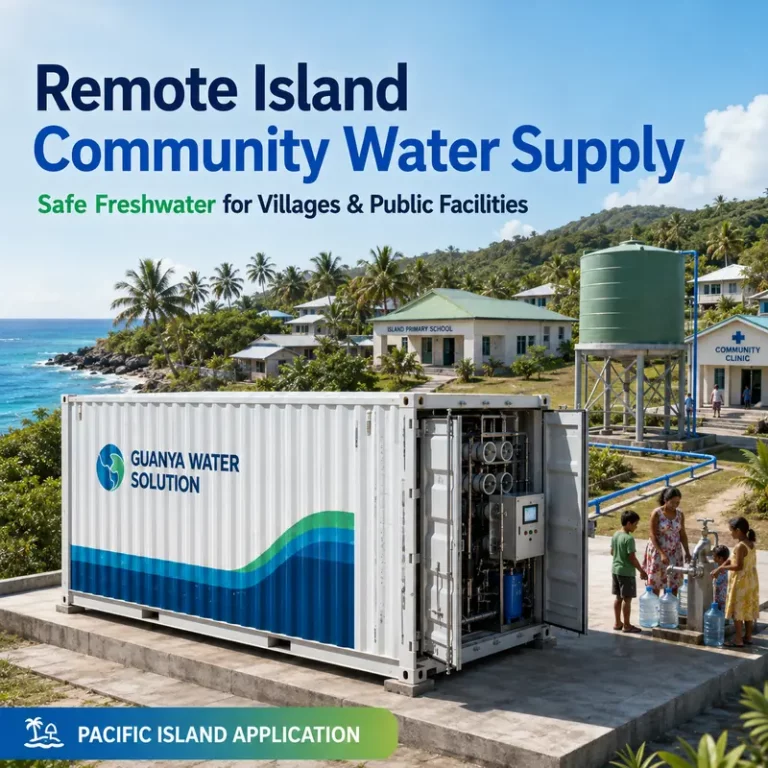
Freshwater availability is a practical constraint for island hospitality projects. Guest rooms, kitchens, laundry and other resort facilities all require dependable supplies, while occupancy levels change throughout the year. Rainwater collection and delivered water may form part of the supply strategy, but their availability and logistics need to be considered alongside daily demand.
An on-site seawater desalination plant provides another source of freshwater where a suitable seawater intake and power supply are available. For this Fiji project, the priorities were a compact installation, equipment protection in a tropical environment and a configuration that allows individual treatment units to operate independently.
The plant must also fit into the resort’s wider water infrastructure. Storage, distribution, final water treatment and operating arrangements are essential parts of a reliable supply strategy.
Three independent SWRO units in one container
The shipment comprises one container housing three treatment units. Each unit has a nominal freshwater output of 1 m³/h, giving a combined rated capacity of 3 m³/h when all three are running.
Production that can follow demand
Independent operation allows the operator to select one, two or three units according to water demand and tank levels. During lower-demand periods, fewer units can run. When demand increases, additional units can be brought into service within the system’s rated capacity.
| Units operating | Nominal freshwater production |
| One | 1 m³/h |
| Two | 2 m³/h |
| Three | 3 m³/h |
Actual output depends on feed water conditions and equipment performance. If one unit is stopped for maintenance, the other two offer a combined nominal capacity of 2 m³/h. Whether this is enough for the resort depends on demand at that time and the water available in storage.
Factory integration for a defined installation scope
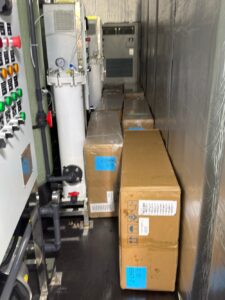
The container brings the treatment equipment, internal pipework, electrical connections, instrumentation and controls together before shipment. Completing this integration at the factory reduces the amount of internal assembly required at the island site and provides defined interfaces for the local installation team.
This approach is useful where access to specialist contractors, tools or replacement components is limited. Factory preparation can simplify site work, while the intake, external pipelines, power supply and storage remain part of the overall project scope.
An enclosure prepared for tropical conditions
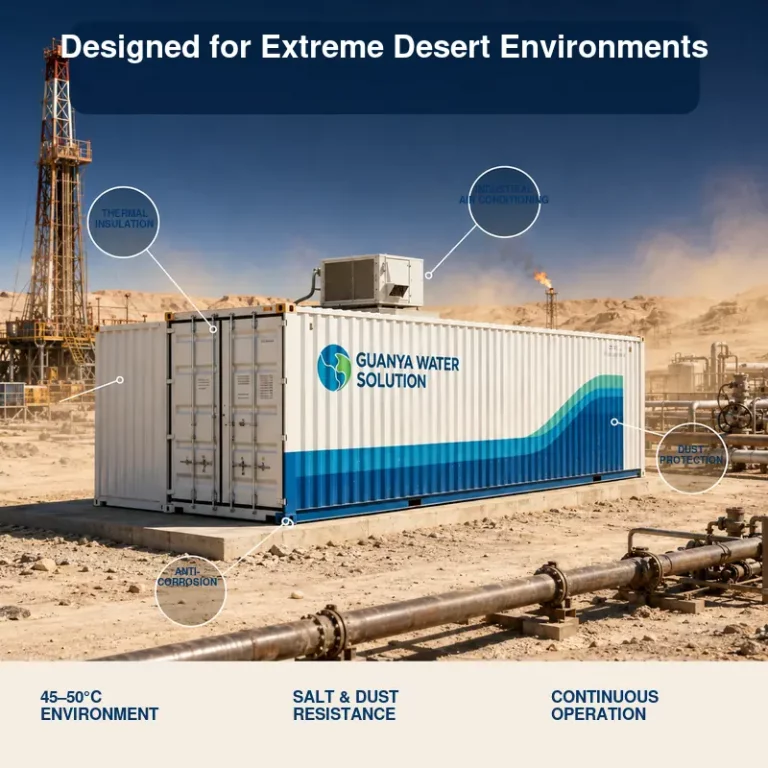
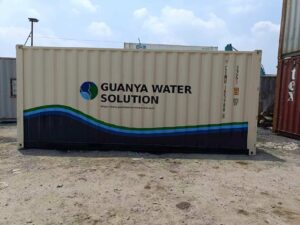
The customized container includes insulation and industrial air conditioning. These features support management of the equipment enclosure in a hot, humid environment and should be considered alongside ventilation, access for maintenance and protection from the marine atmosphere.
Installation planning should allow space around service points and include routine attention to the air-conditioning system. Enclosure cooling also contributes to the site’s electrical load and should be included when sizing the power supply.
Daily freshwater production and storage planning
At a combined rated output of 3 m³/h, theoretical daily production depends on the operating schedule. The figures below assume all three units operate at rated capacity for the stated number of hours.
| Daily operating time | Theoretical freshwater production |
| 16 hours | 48 m³/day |
| 20 hours | 60 m³/day |
| 24 hours | 72 m³/day |
These values are planning calculations, not measured daily production at the resort. Flushing, cleaning, maintenance and changes in operating conditions can reduce the volume available for use.
To select an operating schedule, a resort should assess daily consumption and peak demand separately. Storage can help bridge the difference between steady treatment output and short periods of higher consumption. The required tank capacity should also account for planned maintenance and the site’s backup water arrangements.
What plug and play means for a desalination plant
For a containerized seawater desalination system, plug and play describes a high level of factory integration. It reduces equipment assembly at the destination, but installation still requires prepared utilities, safe connections and commissioning.
Site preparation and external connections
Before the container arrives, the project team should prepare a suitable foundation, an unloading plan and adequate access for operation and maintenance. The installation also needs a seawater feed connection, a freshwater outlet to the storage or distribution system, and a suitable connection for concentrate discharge.
Power supply compatibility, electrical protection and grounding should be checked against the approved equipment documentation. Intake conditions and concentrate disposal must be addressed as part of the site design. Any required post-treatment and disinfection equipment should be integrated with the final water use in mind.
Commissioning before routine operation
After installation, commissioning establishes that connections, equipment operation and water quality are suitable for the intended service. This includes checking for leaks, verifying controls and protective functions, recording operating conditions and testing product water.
The time required depends on site readiness and the agreed commissioning scope. For this Fiji shipment, installation and operating results will be established after site work is completed.
Understanding desalinated water quality
Total dissolved solids, or TDS, is a useful indicator of the dissolved salt content of water. It helps operators track desalination performance, but it does not describe every aspect of water quality.
Water intended for drinking, kitchens or ice production needs to meet the applicable requirements for those uses. Assessment should cover relevant chemical and microbiological parameters, together with any required pH adjustment, remineralization and disinfection. Final water quality also depends on hygienic storage and distribution after treatment.
A project’s rated feed water limit, design performance and measured product water results should be considered separately. For a shipped system, site testing during commissioning establishes the operating baseline under local conditions. Routine records can then help the operator identify changes that require attention.
Maintenance planning for a remote island
A modular configuration supports maintenance planning by allowing individual units to be isolated. It also makes the relationship between maintenance and available capacity clear: taking a unit offline reduces production, so work should be coordinated with storage levels and expected demand.
Operators should follow the equipment manuals for routine inspection and maintenance. Useful operating records include flow, pressure and water quality readings, along with cleaning and service history. Changes in these records help guide investigation and maintenance decisions.
The support plan should define operator responsibilities, training, documentation and the process for requesting technical assistance. Clear equipment identification and operating records make remote troubleshooting more effective and help the local team prepare for maintenance work.
Planning a similar system for your island project
The Fiji configuration is one example of how modular SWRO equipment can be packaged for a resort. Other sites may need different capacities, operating schedules, enclosure arrangements or backup strategies. The starting point is the project’s water demand and available source water data.
Guanya evaluates the treatment configuration alongside site power, intake conditions, storage and transport access. Future expansion should be reviewed against the capacity of these shared services and the available space. Adding treatment modules may also require changes to electrical infrastructure, external pipework or storage.
For locations considering solar energy, the evaluation should include the complete electrical load and operating schedule. Solar generation, batteries and grid or generator support need to be sized as a coordinated system. Solar power is an option to assess for a separate project and is not listed as part of this Fiji shipment.
Frequently asked questions
How much water can this system produce each day
The combined rated output is 3 m³/h. At that rate, 20 hours of operation would produce a theoretical 60 m³ per day, while 24 hours would produce 72 m³. Actual production depends on operating conditions, cleaning and downtime.
Why use three smaller units instead of one larger unit
Three independent units allow production to be adjusted in steps of 1 m³/h and permit one unit to be stopped while the others continue running. With one unit offline, the remaining nominal output is 2 m³/h. Storage and demand determine whether that reduced output is sufficient.
Does containerization eliminate site construction
It reduces internal equipment assembly and provides an enclosure for the treatment system. The site still needs a suitable foundation, intake and discharge connections, a freshwater connection, electrical supply and any associated storage or final treatment facilities.
Does low TDS mean the water is safe to drink
Low TDS alone does not establish drinking water safety. Final suitability requires assessment of the relevant water quality parameters, appropriate treatment and hygienic storage and distribution.
Can the system be expanded later
Expansion can be evaluated, but it depends on the available space and the capacity of the intake, power supply, concentrate discharge and storage. These interfaces should be considered early if increased future demand is expected.
Has the Fiji system started operating at the resort
The system has been shipped. Installation, commissioning and site performance verification are the next project stages.
Discuss your resort water requirements with Guanya
Guangdong Guanya Environmental Protection Technology Co., Ltd. designs and manufactures water treatment equipment, including containerized seawater reverse osmosis systems. We work with project teams to define treatment capacity, equipment integration and the interfaces required for installation.
If you are planning an island resort, coastal hotel or remote water supply project, send us your location, daily freshwater requirement, available water analysis, electrical supply details and target delivery schedule. These inputs help us prepare a technical proposal suited to your site and operating needs.
Contact Guanya to request a technical proposal for your containerized seawater desalination project.
Website publishing metadata
These fields are for the website editor and are separate from the article body.
SEO title
Fiji Resort Containerized Desalination System | Guanya
Meta description
Explore Guanya’s Fiji resort SWRO shipment: three 1 m³/h units in one 20-foot container, with factory integration and flexible production for island water supply.
Suggested URL path
/case-studies/fiji-resort-containerized-desalination/
Primary keyword
containerized seawater desalination system
Related search terms
Fiji resort desalination; seawater desalination for island resorts; modular SWRO system; island resort water supply
Suggested category
Project Case Studies
Internal link anchors
Containerized seawater desalination systems — link to the existing product page. Request a technical proposal — link to the existing inquiry page.